
Robert Morris is the number one reviewer of business books for Amazon.com. A few weeks ago he posted a great review of Hunting in a Farmer’s World, and asked if he could interview me.
 Bob’s questions were really fun, and the interview went rather long. To my surprise, he is publishing the entire thing in two parts. Here is the first half.
Morris: Before discussing Hunting in a Farmer’s World, a few general questions. First, who has had the greatest influence on your personal growth? How so?
Dini: Clearly my Dad. He was in industrial packaging sales. Every night at the dinner table was a seminar in how to solve customer problems, and do it ethically in an environment where ethics were too easily forgotten. (Think Mad Men) He was a high performer, but his standards came before everything else. It’s how I learned that sales was all about helping people with their problems. If he didn’t have a solution, he would direct the customer to a competitor. In turn, the customer would look for future opportunities to do business with him.
Morris: The greatest impact on your professional development? How so?
Dini: This is better answered in the negative. I’ve never had a mentor. I often wonder how things could have turned out if I’d had the opportunity to work under someone who would have tutored me. Because of that, I try hard to focus on finding out what my employees want for their futures, and allowing them the flexibility to pursue their personal visions through or alongside their work.
Morris: Years ago, was there a turning point (if not an epiphany) that set you on the career course you continue to follow? Please explain.
Dini: In my early 30s, I quit my sales job in New Jersey to start a company, with financing promised by a customer. He didn’t come through, teaching me a valuable lesson about making sure of things before I act on them. I was at loose ends when my former employer called. They had been acquired, and the new owners offered me an equity position if I could turn around their California operation. I’ve signed my own paycheck since.
Morris: To what extent has your formal education been invaluable to what you have accomplished in life thus far?
Dini: I dropped out of college about halfway to a degree in English. When I returned to night school, I majored in accounting. My English courses all became electives, so I had four years of night classes in required accounting courses. I never wanted to be an accountant, but understanding how a business works always starts with the numbers. Having that type of long-term immersion ingrained a knowledge base that pays off every day.
Morris: What do you know now about the business world that you wish you knew when you when to work full-time for the first time? Why?
Dini: I think the whole concept of a career path escaped me. I took jobs because I had to eat, and advanced because I had talent; but the idea of setting a long term goal, or of thinking about the next step never occurred to me. Once I became a business owner, I struggled with strategy and planning to reach objectives. I do more of it now, but it still isn’t instinctive. A mentor would hopefully have taught me how better to step back and consider the bigger picture.
Morris: Of all the films that you have seen, which – in your opinion – best dramatizes important business principles? Please explain.
Dini: I recently came across a presentation from the Army War College using the film Twelve O’Clock High (1954) with Gregory Peck as an illustration of how a leader has to change roles as his team develops. It was excellent, and I’m using it in a management course that I teach.
Morris: From which non-business book have you learned the most valuable lessons about business? Please explain.
Dini: I’ve read Any Rand’s Atlas Shrugged five times. I return to it periodically to remind myself that other people (outside my family) don’t have a right to appropriate my efforts. I still do far too much work for free, but I like to help people and that’s entirely my choice.
Morris: Here are several of my favorite quotations to which I ask you to respond. First, from Lao-tse’s Tao Te Chin:
“Learn from the people
Plan with the people
Begin with what they have
Build on what they know
Of the best leaders
When the task is accomplished
The people will remark
We have done it ourselves.”
Dini: Absolutely. One of the nice things about being an entrepreneur is that I don’t have to grab credit for what the team accomplishes. As a business coach, it’s always a thrill when an owner tells me “I wasn’t available, and my people took care of it without me!” It’s tough getting employees to believe that you are just as happy, or happier, to see them succeed without you.
Morris: From Howard Aiken: “Don’t worry about people stealing your ideas. If your ideas are any good, you’ll have to ram them down people’s throats.”
Dini: There is truth in that, but I’ve practiced a habit of saying “I have an idea,” rather than “I have a great idea.” Once you’ve declared your own idea as terrific, you are immediately disposed to defend it. Most ideas could use a bit of improvement, and that comes easier when people don’t feel they are attacking something you’ve put a lot of emotional stock in.
Morris: From Richard Dawkins: “Yesterday’s dangerous idea is today’s orthodoxy and tomorrow’s cliché.”
Dini: Well, as Huey Lewis said, “Sometimes bad is bad.” Dangerous ideas can bring surprising results, but often we don’t like the surprise. Hindsight lets us view the dangerous ideas that worked as obvious, especially if they grow into orthodoxy and clichés, but we tend to forget the ones that were just bad ideas.
Morris: From Isaac Asimov: “The most exciting phrase to hear in science, the one that heralds the most discoveries, is not “Eureka!” (I found it!) but ‘That’s odd….’”
Dini: Many years ago, I had the opportunity to sit with about a dozen students and Dr. Azimov for a few hours. Similar to your quotation, one student asked him “What do you think of the quote “If a writer had predicted automobiles, another would have predicted traffic jams?” Dr. Asimov loudly yelled “WHO SAID THAT?” The stammering student admitted that he didn’t know, to which Asimov puffed up his chest and announced, “I said that!”. His mantra was to question everything. A critical part of every CEOs job is to be asking “What if…?” every day.
Morris: Finally, from Peter Drucker: “There is surely nothing quite so useless as doing with great efficiency what should not be done at all.”
Dini: That goes to asking “What if…?” again. Many CEOs think that Management by Walking Around (MBWA) is to make sure that people are doing what they were told to do. I’ve always thought it was to see if people are doing things they don’t need to be doing.
Morris: In one of Tom Davenport’s recent books, Judgment Calls, he and co-author Brooke Manville offer “an antidote for the Great Man theory of decision making and organizational performance”: organizational judgment. That is, “the collective capacity to make good calls and wise moves when the need for them exceeds the scope of any single leader’s direct control.” What do you think?
Dini: In the Alternative Board, I’ve facilitated over 800 peer group meetings of business owners over the last 18 years. One of the most valuable things that regularly occur in these meetings is when an owner announces an important decision for his company. His logic and analysis is sound, but someone will ask “What if the result is…” (It’s that “What if…?” question again.) A single comment will start a whole new avenue of thought, and the planned action or its implementation is frequently very different by the end of the conversation. Any great leader cultivates the ability to listen. When you have the authority to make a call, and a track record of making the right one, it becomes too easy to think that you have some special intellectual ability that others don’t possess. That’s seldom the case. All ideas benefit from being put under someone else’s magnifying glass.
Morris: Here’s a brief excerpt from Paul Schoemaker’s latest book, Brilliant Mistakes: “The key question companies need to address is not ‘Should we make mistakes?’ but rather Which mistakes should we make in order to test our deeply held assumptions?’” Your response?
Dini: The greatest ideas and advancements come from failures. If we try something and it succeeds, we usually leave it alone. It is only when things don’t turn out as planned that we improve.
Morris: In your opinion, why do so many C-level executives seem to have such a difficult time delegating work to others?
Dini: Reaching the top echelons of any organization requires high performance. Many of those who get there grow frustrated because the people around them can’t perform at their level. They can take the time to teach and coach, but it is quicker and (they think) more efficient to do it themselves. Who gets more accomplished, ten people who each do something 80% as well as you, or you? C-Level execs know that they shouldn’t be on the factory floor assembling widgets, but when it comes to knowledge work they frequently set the bar too low when deciding what is worth their time.
Morris: The greatest leaders throughout history (with rare exception) were great storytellers. What do you make of that?
Dini: Storytelling was the first form of mass communication. We are instinctively inclined to give stories weight, as they are how we learn from childhood on. I joke that my favorite bedtime stories started “Jack McCarthy was looking out the window of his corner office, wondering where the plan had gone wrong.” That’s stretching it a bit, but illustrating by putting a lesson in the context of a real person in a real place lets the reader (or listener) visualize the scenario. It sticks so much better than an abstract discussion. That’s why my books are filled with stories of real people, rather than “consulting wisdom.”
Morris: Most change initiatives either fail or fall far short of original (perhaps unrealistic) expectations. More often than not, resistance is cultural in nature, the result of what James O’Toole so aptly characterizes as “the ideology of comfort and the tyranny of custom.”
Here’s my question: How best to avoid or overcome such resistance?
Dini: A Japanese CEO once told me about their ringi process of widespread input on decision-making. He said that American CEOs grew frustrated with the length of time it took to bring so many people into the decision circle, and boasted that they were the sole decision makers for their organizations. He had noticed, however, that once an agreement was reached, the Japanese company moved directly into implementation, while the American CEO spent the first few months trying to get everyone on board with “his” decision. Change initiatives are too often hatched in a bubble, and die from a lack of buy-in among the people who are being asked to make the change.
Morris: In recent years, there has been criticism, sometimes severe criticism of M.B.A. programs, even those offered by the most prestigious business schools. In your opinion, in which area is there the greatest need for immediate improvement? Any suggestions?
Dini: MBA programs, like all of higher education, have become trapped in bureaucracy. Textbooks tend to be written about large organizations, and the cycle of research, writing, publishing and acceptance into classrooms takes years. Some entrepreneurship programs are inviting young, successful CEOs to lecture, but they tend to be focused on tech millionaires. I’d like to see more focus on the mid-market companies that create most of the jobs. Perhaps include a practicum where students take a well-run company and try to generate measureable improvement without the capital and other resources that very large organizations can deploy. It isn’t easy.
Morris: Looking ahead (let’s say) 3-5 years, what do you think will be the greatest challenge that CEOs will face? Any Advice?
Dini: The mismatch between education and the talent needs of business. Skilled tradespeople are ageing rapidly as a group, and we are producing far too few engineers and scientists. We feel the pinch already. In five years it will be worse, but in ten it will be critical. Demographics can’t be changed in that short of a time. Businesses, especially small businesses, have always been the trainers of last resort for early-career employees. I think that role will grow. The CEO’s challenge is going to be how to develop employees’ skills without just making them a more valuable commodity for a competitor.
Morris: Years ago at one of GE’s annual meetings, then chairman and CEO, Jack Welch, explained why he admired small companies:
“For one, they communicate better. Without the din and prattle of bureaucracy, people listen as well as talk; and since there are fewer of them they generally know and understand each other. Second, small companies move faster. They know the penalties for hesitation in the marketplace. Third, in small companies, with fewer layers and less camouflage, the leaders show up very clearly on the screen. Their performance and its impact are clear to everyone. And, finally, smaller companies waste less. They spend less time in endless reviews and approvals and politics and paper drills. They have fewer people; therefore they can only do the important things. Their people are free to direct their energy and attention toward the marketplace rather than fighting bureaucracy.”
Here’s my question: Which of his comments do you consider most important to leaders in Fortune 100 companies? Please explain.
Dini: All true but, as a lifelong small-company guy, I look at Fortune 100 companies and can’t see what they might do to be more nimble or less bureaucratic. A CEO’s primary job is to communicate the vision to everyone. As Simon Sinek says, “Why are we doing this?” When you have thousands of employees, standardization is a necessity, and I think the creep from following the vision to following the rules is inevitable. You could work in much smaller units, but surrendering economies of scale wouldn’t please the financial markets, and probably would lead pretty quickly to a new CEO.
In business, everyone is either a Hunter or a Farmer. Which one are you? Take the quiz. www.hiafw.com 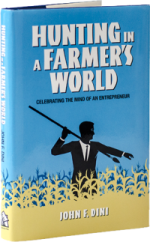







Perceptive & so true
Well done sir. Thank you for looking out for small business. Every dollar counts for us. We don’t have the luxury of throwing good money down the drain.