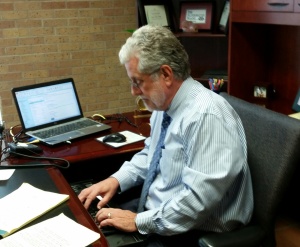
Another small business owner defrauded

I’ll be in Denver, sharpening my saw all weekend at the semi-annual conference of The Alternative Board®, so I’m posting early this week.

I had an evening call from a client last night. He recently discovered fraud in a small branch office. Although he terminated the employee (the branch manager) the problem keeps growing. As he said last night; “Some things, the longer you chew on them the bigger they get.”

Well over half of our clients admit to having been defrauded by an employee sometime in the past.The more cynical of us say that the rest just haven’t figured it out yet.

ALL employee fraud in the workplace has three components: need, opportunity and rationalization. Ten to fifteen percent of employees will look for a way to steal as soon as they walk in the door. About the same number wouldn’t take a dollar if it was left collecting dust on heir desk for years. The 70 to 80% in the middle are situational thieves. They first have to have a need. Bill collectors are calling, a family member is sick, a vehicle is broken down.

The opportunity is some flaw in your systems, a chink in your armor, that allows them to think the theft will go unnoticed. In this case the branch manager collected cash during the day, and faxed the deposit slip to the main office every afternoon at close. The chink? She only faxed the front of the slip. The back (where the bank stamped for receipt of the deposit) wasn’t checked until the statements came into the head office after month’s end.

The rationalization? Her tax preparer told her she had a big refund coming. Bill collectors were calling. She thought “Why should I face his harassment for weeks to come, when I can slip some money out of the deposits, pay my bills, and put it back before they know it?”

Her type of fraud is called “kiting.” She took money from one deposit, and rolled back money from future deposits to cover it. The deposits were just dropped at the bank a few days late. A simple check of the date stamp would catch it, but the owners weren’t looking. After all, a deposit was being made for each day of business, and the clerk reconciling the statement just assumed the bank took a couple of days to get them on the books.

Most employees start out thinking they’ll put the money back. Then nothing happens. They are nervous for a week or two, but that soon wears off. They start thinking that they will never get caught. She quickly expanded her operation to a second receipt book for customers, and phantom entries for missing payments in the computer. Pretty soon she was doing so many things it had to draw attention, but by that time she was into the owners’ pockets pretty deeply.

Remember- No small business owner has ever been defrauded by an employee he didn’t trust.

Posted in Management | Tagged , , , , , , | Leave a comment

Leave a Reply

Your email address will not be published. Required fields are marked *

Stoplight 360

I recently saw a fast and easy way to rate your employees that makes the high performers and low performers stand out in a way that can’t be ignored.

It uses Stop light Methodology: a red-yellow-green marking system. The advantage of Stoplighting is that everyone gets it. It is ingrained into our way of thinking (or at least the thinking of everyone in America who drives- which is close enough.) It’s the proverbial “no assembly required” scoring system.

I saw this used in a topgrading process. A client who owns a professional firm was trying to determine which employees were most likely to advance, and which were least likely to make it in the company. Although the managers were charged with reviewing and critiquing performance; he knew that the managers didn’t see every aspect of the employee’s work.

So he wanted to do a 360 feedback. For those who may not know, a 360 asks everyone to review an employee. It is given to his/her superiors, peers and subordinates.Done right, it can be a very accurate portrayal of all an employee’s differing roles in the organization.

But the comprehensive administration of 360 instruments and their consolidation can be time consuming and expensive. Enter Stoplight Methodology.

Each employee was given a list of every other employee in the company, and asked to mark them green, yellow or red. Green meant they were effective at their job, good to work with, and generally a keeper. Yellow meant they weren’t strong in all areas, but could be great with some improvements. Red meant that they had too many flaws to be considered a long-term player in the firm.

All answers were kept confidential, of course. The results were put into a simple spreadsheet, with all the employees listed on each axis. The results were a dramatic graphical rendition of each employee’ relationship throughout the organization.

Surprisingly, an obvious difference was with employees whose managers considered them “yellow,” meaning could be a keeper with some work. Some of these were scored as “Greens” by their peers and subordinates, but many were strictly red lights. That was a wake up call to how many managers were accepting low performers, perhaps because replacing them meant more work for the manger himself.

Try it in your business. It’s fast, easy and fun. (Well, at least for some people…)

Posted in Leadership, Management | Tagged , , , , , , | Leave a comment

Leave a Reply

Your email address will not be published. Required fields are marked *

The influence of one man

I promised to return with the true story of the difference one man can make.

If Sam knew that I was talking about him in my blog he’d be embarrassed. Recognition isn’t his thing. In fairness to Sam, I’m not writing about him, but about the effect that one motivated individual can have. Like the shopkeeper in Haiti whom I wrote about last month, Sam isn’t a hero, except to the people who benefit from his efforts.

Sam is a retired colonel with a second career in banking. He’s been retired from his second job for another 15 years or more. He spends his time working in the community, as a church volunteer as well as in anything he thinks is worthwhile. One of those worthwhile efforts is Habitat for Humanity.

Sam first joined a bunch of his ROMEO breakfast buddies (Retired Old Men Eating Out) in spending one day a week doing catch up work on Habitat houses. Most Habitat volunteer work happens on weekends, for obvious reasons. The well meaning volunteer workers frequently don’t get enough done to keep the build on schedule. Sometimes they get in over their heads, or do something to the best of their ability, but not of the quality that it should be. Habitat uses some handy guys who volunteer to go out in between weekends to fix, redo and catch up these problems. Sam helped out on one of these.

He grew more interested in the Habitat effort, and took their orientation class for volunteer leaders. A devout Catholic, he asked how many Habitat houses went to Catholics in the predominantly Hispanic poor community of San Antonio. It was about 75%. Sam wasn’t being exclusionary, because his next question was “Why don’t I see any Catholic Churches participating in Habitat?”

The Habitat executives explained that since the organization’s roots were the Baptist and Evangelical communities around Atlanta, the Catholic community had always seen Habitat as more of a Protestant effort. Sam found this ridiculous, and said so then, and when he returned to his own parish. A respected leader in his church, Sam got permission to talk to the community about building a Habitat house.

The response was favorable, and the money was quickly raised. In my opinion, Sam had found a basic truth about asking for anything. Give the request a specific purpose and outcome, so that people can quickly decide whether they want to be involved or not. His focused request to do something tangible for specific and deserving people (Habitat ownership requirements are very stringent) in the local community hit a chord.

Sam took the show on the road. He went to other parishes to request time at their podiums. Some declined, but not all. Once he saw the enthusiastic response, he went back to the demurring churches and asked again to speak. Some took multiple tries, but Sam didn’t give up.

Step by step, campaign by campaign Sam built a donation and volunteer network. He’d coordinate multiple parishes who felt they couldn’t afford the effort alone. He’d put poorer parishes with little money, but lots of skills, together with richer ones that could collect checks but not hands and backs.

It’s 13 or 14  years later. They don’t let Sam climb on roofs to shingle anymore, but he still shows up to supervise on almost every build weekend. Well over 100 families live in their own homes due to the efforts of one man. More than 5,000 people have volunteered where virtually none would have done so before.

If Sam hadn’t been busy serving his country, he would have made a great small business owner.

Posted in Leadership | Tagged , , | 2 Comments

2 Responses to The influence of one man

  1. Dan says:

    Well said John. A fitting tribute to an inspiring man

  2. Well it’s 2 AM, no kidding.
    Thanks for the story about a great small businessman that has his own franchise working for the greatest man who ever lived. The franchise is free but it’s not cheap, it doesn’t pay well, you have to work everyday for the one payday and that day is priceless. Sam is a great businessman.

Leave a Reply

Your email address will not be published. Required fields are marked *

Is America the next Rome?

James Fallows has written a massive, thought-provoking  article about America’s current social, political and economic issues in The Atlantic. Like so many of us that have spent time overseas, he looked at the US with fresh eyes on his return.In Fallows’ case, he moved his family to China for three years so he could have a deeper journalistic perspective about that country’s role in the 21st century, and moved back a couple of months ago.

He comes to mixed conclusions about our issues, but they are even handed and well thought through. If your tendency is to skip these pieces because “I don’t need to hear about how bad our country is.” you are wrong. It isn’t that kind of approach at all. If you want a serious discussion about how we can regain some of our lost energy as a nation, and about the complexities of the issues we face, this is the best place to begin that I’ve seen, maybe ever.

I confess to being a huge Fallows fan. I think he, along with Thomas Friedman, is one of the clearest voices on world dynamics and what we need to be aware of. I agree with Fallow’s politics more often than I do with Friedman’s, but both are sharp guys.

In lieu of writing a blog today, I’m inviting you to print and curl up with Fallows’ article. It is very long, about 10,000 words (or the length of a good short story,) but it is worth every page.

Posted in Thoughts and Opinions | Tagged , , , , , , | Leave a comment

Leave a Reply

Your email address will not be published. Required fields are marked *

Leadership

There was an interesting report on National Public Radio earlier this week about Haiti. I tried to link it here, but I couldn’t find it in the hundreds of archived earthquake stories. If someone locates it, please let me know so I can post the link.

The story was about the neighborhoods that had not seen any aid workers days after the quake, but were functioning without outside help. They weren’t fine by any means, but they had managed to marshal resources, care for the injured and distribute food and water. There were no roving gangs or crime, even though they were in the middle of Port O’ Prince.

The neighborhood the story focused on had been organized by a small business owner. (Are you surprised?) This shopkeeper, shortly after the temblor, has gathered the stunned people and started directing them to move the injured. He organized stretcher bearer teams. He consolidated the water and food and had it guarded and distributed fairly. He commandeered a place for the wounded, where they were stabilized within the locals’ limited means. He sent out people to search for the nearest functioning medical facility, and began transporting the worst cases to it.

I’m extrapolating a bit. The story didn’t describe the step by step process of organizing the neighborhood, they just talked about the result. Any of us who direct people for a living know how it happened. One person stood up and took responsibility for impacting his environment. When others were saying “Why me?” or “Who will help us?” he said “What can I do?” and “How should we deal with this?”

The third and fourth questions are ones that small business owners ask every day. The first two are the ones asked by people who can’t or won’t take control of their lives. I highly recommend John Miller’s “QBQ– The Question Before the Question.” I’ve met John, and he leads a crusade for personal accountability. He points out that “Why?” and “Who” questions are usually about avoiding accountability, and “What?” or “How?” questions are about taking on the responsibility for a solution.

Leadership begins with accountability. The story of neighborhoods in Haiti is a great example of how one man (or woman, in many cases) can simply decide to change things, and others will follow. In my next blog I’ll talk about my friend Sam, who has changed the lives of hundreds of people forever, without publicity, notice, or giving up his active life.style.

In he meantime, remember the words of Henry Ford. “Asking why a man should be the boss is like asking why he should sing Tenor in the choir.”

Posted in Leadership | Tagged , , , | Leave a comment

Leave a Reply

Your email address will not be published. Required fields are marked *