Recessions, Recoveries Bring Out the Sharks

This article appeared in the San Antonio Business Journal on Friday, March 4th

A number of our business owner clients have been calling lately to ask about an offer that seems too good to be true.

The owner gets a call saying that a top business consultant will be in the area a few weeks from now. Although this consultant typically charges several thousand dollars a day, he has noticed an opening in his schedule. Rather than be idle, he is willing to take the time to do a complete assessment of your company at a greatly discounted price.

There are several national companies that use his approach, but the result is always the same.

The “consultant” is actually a salesman, and you’ve just purchased an eight-hour sales call.

The representative is trained to search your company data, and to conduct an interview that focuses on your weakest points. If you are cooperative, he will continue asking for information until he can identify your greatest pain in running your business.

The sales close can last for hours. He has specialists in your specific area of weakness, and they can transform your business in less than two weeks.

The cost is typically between $20,000 and $30,000. I know one owner who, desperate for help, used six different credit cards to pay the fee, which is always charged 100 percent up front.

Will you get help? That depends.

Most owners I know who have engaged one of these companies (and I know over a dozen) say that the suggestions were valid, but completely generic. They consist of “ideas” like: “The Company’s salespeople are underperforming in the owner’s opinion. We recommend that a sales compensation plan be introduced that relies more heavily on commission-based incentives.”

Is a three-ring binder or a CD filled with this kind of advice worth $30,000? I have yet to meet an owner who found real value from the advice, or who felt that the engagement rendered any lasting change in his or her business.

How do you spot a potential rip-off?

Legitimate professionals have only their time to sell. They don’t hire telemarketers to offer their skills at deep discount.

Every consultant I know will offer a no-cost initial meeting to determine the potential client’s needs, and to determine whether he or she is able to deliver the appropriate skills. While an initial retainer isn’t unusual for consultants, most proposals have a substantial portion of the payment due only after the consultant has completed the work to the client’s satisfaction.

Charging for an initial meeting, and charging all the fees before the project even begins are both red flags.

An effective advisor is willing to let the results of his or her work be the determining factor in payment.

Business owners in trouble are like blood in the water. Predators look for the weakest prey to attack first.

If you need help, ask around your business community for recommendations to a professional who has referrals from previous engagements, and who can use past clients as testimonials.

Buying a discounted “deal” from a telemarketer is never the magic bullet they claim it will be.

Posted in Uncategorized | Tagged , , | Leave a comment

Leave a Reply

Your email address will not be published. Required fields are marked *

Does the Economy Affect Your Business?

I love this quote from Paul Krugman in a breakfast speech a few weeks ago.

“The Financial Industry rolled along extending credit to everyone, until they had their Wiley Coyote moment. You know how that works. Wiley Coyote runs off a cliff, but according to the cartoon laws of physics, he doesn’t fall until he looks down.”

That is a pretty good description of how the world financial system failed. In fact, the US economy was already in its third quarter of recession, and pundits, including the Long Johns of Britain, had brilliantly predicted the outcome for financial companies seven months before the collapse of Lehman Brothers.

If you read the contrarian economics websites, they are still looking for the next crash. Whether it is the surging foreclosure numbers, the resetting of Alt-A mortgages (which peaks in mid-2011), the withdrawal of Asia from the US bond markets, oil prices at $150 a barrel, collapse of an overheated real estate market in China, Quantitative Easing by the Federal Reserve (QE2) or the surge in commodity prices, there are plenty of potential scenarios to keep the doom and gloom crowd active.

In the meantime, my January prediction of recovery in South Texas seems to be coming true very quickly. Our February Board meetings were full of record sales, and the need to start hiring again. Should business owners jump on this as soon as there is evidence, or should they hold back in fear of another meltdown?

That depends on your business. If you are dependent on financing (as in commercial construction) or on capital expenditures (such as manufacturing) what happens on Wall Street can clearly affect what happens to you. If you are part of the local economy (retail, restaurant, services) then you may see an impact in your market, but you don’t have to see one in your business.

I know a restaurant whose pre-recession growth was between 8% and 10% annually. During the depths of the recession, it fell to 3-4% growth. No decline, just a minor slowing in the rate of increase. Other restaurants I know in the same area fell by almost 20%. Was it the recession, or were they just less able to compete in a tougher market?

A lawn service company I know grew 40% between 2008 and 2010. Scores of lawn maintenance companies in the area went out of business in the same time frame. A packaging distribution company grew over 20% during that time. An accounting firm by 18%. A construction company by 10%.

These businesses didn’t exist in a vacuum. Their customers didn’t have new sources of discretionary income. These owners were subject to the same challenges as the rest of us. They didn’t have massive cash reserves to market or advertise when everyone else pulled back. They did have excellent management, a focus on their customers, and systems to maintain profitability.

I typically meet (for the first time) between 20 and 30 business owners a month. Believe it or not, through the end of 2007 I still heard poor business performance attributed to “The effects of 9/11.” Now I’m sure those same owners are shaking their heads knowingly and saying “It’s the recession, you know.”

In the meanwhile, other small businesses continue to grow and thrive in the face of all indications to the contrary. Some 53% of our clients had record years in 2010. That isn’t nearly as good as in prior years, but it isn’t bad, either.

We might have another economic shock, or we might not. One thing is certain: our businesses have been tested, and we are supposed to have learned from the experience. If you are just now surfacing from survival mode, it is time to put the lessons to work. Make your business a ruthless and formidable competitor. Things will slow down again someday, and you want to be one of the success stories the next time.

Posted in Thoughts and Opinions | Tagged , , , , | Leave a comment

Leave a Reply

Your email address will not be published. Required fields are marked *

Employee Incentives that Work

After four blogs on the long term motivations for running a business, perhaps it is time to return to some more practical advice. One of the most persistent issues for a business owner is trying to motivate employees with incentives.

You install a perfectly good incentive plan. It gives the employee opportunity to make more money, or to enjoy a perquisite outside his or her normal compensation. You roll it out with appropriate fanfare. The feedback is positive. The workers are excited. Then…nothing.

What happened? Was it the plan, the goals or the employees themselves?

Frequently the answer is all three. Here’s a quick primer on why each element in the process can fail, and how to work through it.

The plan may not have been easily understandable. If it requires the employees to wait until management tabulates the numbers and tells them if they’ve won or not, it is worthless. It’s like bowling under a curtain. Effort, noise, but no idea of where you are in the standings.

The goal must be achievable. I often recommend a goal in the beginning that is the same or only a little more than what they do already. You need to get the employees into the habit of winning, but winning with effort.

Employers get lazy with incentive plans. They try to tailor a one-size-fits-all. If the employees succeed in earning $100 each in the first bonus period, then logically they’ll want to get $200 each in the second, right? Actually, no. They will usually try to earn the $100 again, and again. Increasing performance requires a willingness to change plans often. It also means changing them even when they are working, before they run out of steam.

Aaaarrgh! I can hear the moans in my reader community. “It’s hard enough to develop one plan. How am I supposed to keep coming up with new things all the time!”

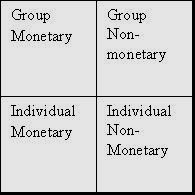
Actually, it’s easy and effective. Use the old BCG (Boston Consulting Group) two-by-two matrix. That’s where you have four sectors, and each represents a combination of two factors. My thanks to Gerald Stowers, the President of Execupay for showing me this one.

Draw a square on a piece of paper. The divide it into quarters by bisecting it top to bottom and left to right. Then label the Y axis “People” and the X axis “Type.”

We are going to vary the incentives by two factors: whether they are for a group or an individual (People), and whether they are monetary or non-monetary(Type). You should wind up with something that looks roughly like this:

A short guide to the types:
  • Group-Monetary: “If the whole team averages 85% customer satisfaction, there will be a $100 bonus for each team member.”
  • Group Non-monetary: “If everyone on the team opens at least one new account this month, we’ll all have a pizza party.”
  • Individual Monetary: “The highest producer will receive a $500 bonus.”
  • Individual Non-monetary: All kinds of things.Trips and tickets are popular, but this category includes a lot of recognition. Trophies, pins, plaques and such.
Most business owners are Hunters, as the introduction to this blog suggests. They lead teams, but expect to reap individual rewards for their efforts. Not all of your employees are the same as you.
Some are hunters, of course, but even so they may not be all that motivated by money. Recognition, or a change in the routine (an extra 3 days of paid vacation) may excite them a lot more.
Your farmers are more likely to be excited by helping everyone. “Let’s all do this together” is their battle cry. Of course, the hunters involved in these type of programs will be the ones to pressure the low performers. Team incentives work because the motivated individuals push the team for their own benefit, while the team players do it for everyone’s.
Change incentives regularly. If something works well, don’t just ride it until it becomes ineffective. Terminate it according to schedule. If it was popular, it will just be that much more exciting the next time you use it (with a higher goal, of course).
Keeping incentives fresh, simple to track, and varied enough to appeal to different personalities will make them far more effective. 
Posted in Management | Tagged , , , , , | Leave a comment

Leave a Reply

Your email address will not be published. Required fields are marked *

Lifestyle or Legacy – Part 4

Last week a client told me “You are wrong. I have a lifestyle business that is ALSO a legacy business.” Sorry, but that doesn’t fly.

He has built a good company, and continues to improve it. Be he is not driving to make it into something that carries on beyond him. His objective is to (eventually) make it large enough to be acquired, and for enough money to live in luxury for the rest of his life.

That is a lifestyle business. It’s only purpose is to fund the financial aspirations of the owner. There is no larger purpose, no overarching vision of something beyond his quality of life. I’ll grant that his personal ambition extends beyond his current, very comfortable existence. But it only extends to a more comfortable existence. That is a matter of degree, not direction.

When I started to think about this series, the term “lifestyle” was easy. The second term was originally “entrepreneurship.” That didn’t communicate the concept well enough. Thinking through the topic, it reduced the definition of “lifestyle” to more of just making a good living, and of “entrepreneurship” to building something larger than merely a decent living.

What I am talking about encompasses ANY lifestyle you choose. Whether it is a nice house in the ‘burbs, or sailing around the world in a yacht, that is still lifestyle. We all have different targets.

Legacy is when it moves beyond you, when the company becomes a vehicle for accomplishing something larger than your personal quality of life. By that definition there are probably legacy businesses that don’t provide a luxurious lifestyle, but they satisfy the owner’s desired level of creature comforts and support that bigger vision. Perhaps something that allows an owner to go on missions to Africa for half of each year might qualify. For the most part, however, owners have to reach a pretty comfortable lifestyle before legacy comes into the picture.

Most legacy businesses were lifestyle businesses first. The owners scratched and pushed (or were incredibly lucky) to build a level of security and sustainability. Once they got here, however, they looked around and said “This isn’t enough. Mere wealth doesn’t fill the need I have inside of me.”

Another owner said to me ” I want a legacy business. I want to go visit my outlying offices and not fix problems. I’d fly in, give awards to the top performers, and take a major client out for golf.”

That is also a lifestyle business. The legacy owner wouldn’t be coming in to fix problems either. He or she might be looking for an acquisition in that market, or communicating new goals. He might be upgrading personnel; not because they were failing, but because he was constantly looking to do better. The numbers are still important, but they aren’t going towards improving his lifestyle, they are being used to build the legacy.

Before you start worrying about the lifestyle vs. legacy decision, let me make something plain. Some 80% of small businesses fail in their first few years. Of those that survive, probably 90% never achieve the lifestyle level of success. There are very, very few owners who reach a point where they can work as little as they want and make as much as they want.

Some do, and a few of those think “OK. Is that it?” Some of those can’t envision anything else. Some start building a legacy.

To quote Nancy Barcus: “The closer one gets to the top, the more one finds that there is no “top.”

Posted in Exit Options, Exit Planning, Exit Strategies, Leadership, Life After | Tagged , , , | Leave a comment

Leave a Reply

Your email address will not be published. Required fields are marked *

Lifestyle or Legacy – Part 3

Let’s turn to the Legacy Builders.They are the business owners who have achieved Lifestyle status (as defined in the last posting) but continue to work hard to build their businesses. Their objective is a company that does far more than merely provide a comfortable lifestyle and assure retirement.

A little bit of elimination to start, as we did with the Lifestyle owners. Just as we said a Lifestyle Business was neither a pumped-up hobby nor merely an adjunct to an alternative lifestyle, the Legacy owner isn’t a couple of things that people might normally assume.

Let’s set a baseline. The typical Legacy Builder runs a business that is very capable of continuing its day to day activities independently and indefinitely. Operations, management and sales are handled by competent employees. In fact, each is probably better than the owner at what he or she does. They are in the top 1% of American incomes. It varies widely, but we’ll call it a minimum of $500,000 a year. The Legacy Builder nonetheless chooses to work a full (45-50 hour) week to continue developing and improving the business, and not incidentally adding to its profit.

The Legacy builder is clearly not obsessive-compulsive, a workaholic, or in any other way driven unwillingly to work beyond common sense. It’s easy for observers (and sometimes family) to accuse the Legacy Builder of being enslaved to the job, unable to tear away for a personal life. That isn’t true at all. The Legacy Builders I am describing spend time with family and other pursuits. They coach Little League, attend recitals, and are active in the community. They take nice vacations (usually with family), and live in nice homes (often several of them), but are seldom ostentatious.

It is true that they are frequently missing in the devotion of time to community activities, preferring to fund the work of others. In fairness, I’ve spent a lot of time working in community organizations. There is a lot of wasted time. If I had the money to pay for someone else to do it, I probably would. Legacy Builders don’t like to have their time wasted.

They are also not greedy. Their continued push for improvement is not for the personal gain. They seek greater success for other reasons. As Bill Gates once said, “Money is just a way to keep score.”

I call them the Legacy Builders because they have an eye for a target that is beyond merely running a successful business. They have a bigger picture; a larger objective in mind. Developing an organization that lives beyond their own careers is at the core of their strategy, but it isn’t just monument-building that drives them. It is what that organization can accomplish.

Some are motivated by the benefit to the community that their talent can deliver. More jobs, more people who can provide security for their families. For others it is even a greater community responsibility, the money to form a foundation, or to fund worthwhile causes. For others their family is the motivation. They seek to change the lifestyle of their children, and their children’s children, permanently (or at least for the next few generations).

Many of the Legacy Builders are simply entrepreneurs without a limit on their creative drive. Most business owners have a difficult time looking backwards. Yesterday’s achievements are ancient history. They see no point to basking in past accomplishments when there is so much more that could be done.

Some Legacy Builders attempt things for the thrill of accomplishment. Once attained, the successes immediately become the basis for the next level, the next mountain to climb.

Admittedly, a substantial number of Legacy Builders have a head start when compared to bootstrap entrepreneurs. They achieved a substantial level of success in an existing organization, and used that as a spring board for their own purposes. They may come from a family where there was Legacy-type success in the past. They may have just been lucky. But none of those things explain their push for greater achievement in business when they are long past the point at which most owners would be satisfied; and there are plenty of bootstrap start-ups in the Legacy class to disabuse the notion that the game is fixed at the start.

Most Lifestyle owners say that they really want to reach Legacy levels, but few actually do. In my next post, the last in this series, we’ll look at what it takes to make the leap from Lifestyle to Legacy.

Posted in Exit Options, Exit Planning, Leadership, Life After | Tagged , , , , | 1 Comment

One Response to Lifestyle or Legacy – Part 3

  1. Trina Hoefling says:

    Great series you're building here, John! Spot on. Thanks, Trina

Leave a Reply

Your email address will not be published. Required fields are marked *