Black Swans and Small Business Plans

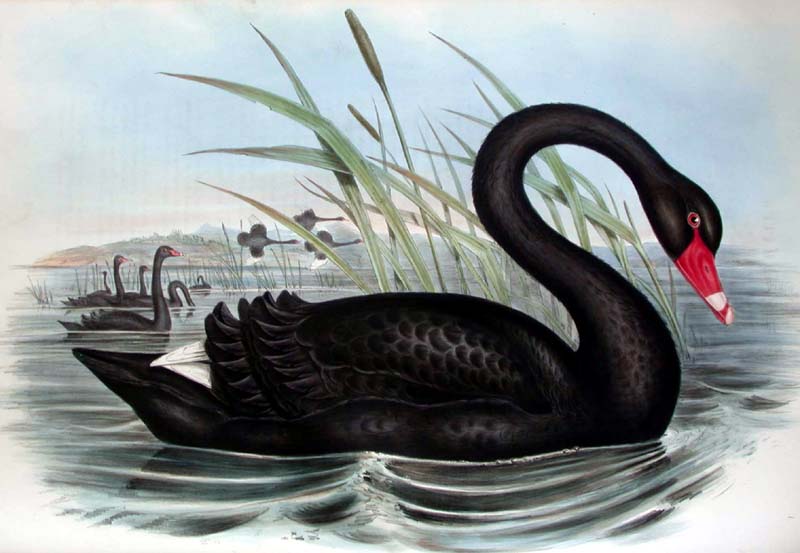
The term “Black Swan” has become immensely popular on Wall Street and in the media to designate a rare occurrence. Google “Black Swan Japan earthquake” (which is popular enough that Google will fill in the last 11 or 12 letters for you) and you’ll find hundreds of articles comparing that seismic event and the rare bird.

The term “Black Swan” comes from Nassim N. Taleb’s bestseller of the same name. Like most ideas popularized in the media, they got it wrong. Taleb’s point is that Black Swan events, those that are considered highly improbable, actually happen all the time.

Black Swan upon Black Swan?

So is a 9.0 earthquake all that improbable? They happen regularly in history (every few hundred years). There hasn’t been one in almost 200 years. Just because we haven’t seen one since the early 19th century doesn’t make the modern world immune to them.

Nuclear accident? With over 500 reactors either in operation or under construction, and a planned life of at least 30 years (many going beyond their scheduled life), that is well over 15,000 years of operation. With their huge water requirements, most are near the ocean. in 15,000 operating-years, how weird is it that something might go wrong?

Swans and Small Business

My point isn’t to prove Taleb’s theory. I am more concerned about my client who owns a motorcycle dealership. After suffering through a recession that closed the doors on 50% of the motorcycle franchises in America, he is seeing a comeback. Now he has supply chain issues. Will an earthquake and nuclear melt down cripple a small business in the Texas Hill Country?

Taleb’s hedge fund strategy is to bet against everything, in the belief that a Black Swan will occur somewhere with regularity. He has been enormously successful. One reason for this is the fact that, in a global context, huge events occur regularly. If you can cover all the bets, one will pay off. There will inevitably be a financial crisis, a sovereign default, a commodity bubble or a natural disaster somewhere.

Should the inevitibility of a disaster make it part of a small business owner’s planning process? Probably not. The motorcycle dealer could spend time and money preparing for a supply chain disruption, but it wouldn’t have been a wise use of his resources. If he started his dealership in 1980 and sold it after 30 years in business, the issue would have never come up.

The Boy Scout Strategy

The Scout’s motto is “be prepared.” While planning around a Black Swan event is beyond the capabilities of the average small business owner, it doesn’t mean that you should ignore the evening news. Too many owners think that nothing outside their own market will affect them. They think that because they are dependent on a large corporation for a critical part of the business, the big company will do the risk planning for them.

If there has been anything proven by the events of the last decade, it’s that the big corporations aren’t ready for these events either. Where were the strategic planners when Japan embraced sole-sourcing and Just In Time inventory? They were driven by profit. Apparently that trumped having a plan B.

Small businesses survive by being nimble. Global connectedness means that an event on the other side of the world can, and does, have an impact on a small local company. You may not be able to prepare in advance, but you also can’t assume someone else is going to take care of the problem for you.

Posted in Entrepreneurship | Tagged , | Leave a comment

Leave a Reply

Your email address will not be published. Required fields are marked *

Your Fault. My Consequence.

My friend Larry Linne, the author of “Make the Noise Go Away” has a great saying about employee mistakes.”Your Fault. My Consequence.” A good employee will accept responsibility, and be accountable for screwing something up. Unfortunately, it is still the owner’s consequence. As the owner, you have to spend the time, the money, and the effort to resolve an error you didn’t make, and probably wouldn’t have made.

“Your fault, my consequence” is felt by owners universally. It often leads to anger and frustration. You just worked your butt off to close a new account. It will finally give you a little financial breathing room this month. Then you return to the office, where your manager informs you that the plant supervisor forgot to schedule that rush order you promised last week, and a top customer has taken his business elsewhere.

Any business owner, whether or not you manufacture, felt the pain in that last paragraph.It has happened to all of us from time to time. What is the appropriate reaction? The supervisor can’t pay you back. He is sorry. He does his job well otherwise. Do you fire him, and go through the learning curve with another employee? Do you chalk it up as an expensive  “learning experience?”

His learning- your expense. You can’t make the employee feel it the way you feel it. You know that even the best employee’s pain is limited to going home and saying “Gee honey, I really screwed up today. I feel bad.” He doesn’t feel as badly as you, however, because he isn’t going to see the results of that lost customer in his paycheck next month, and the month after that, and the month after that. You will continue to pay for his mistake long after he has forgotten it.

What if you blew up six months from now? When he says that he needs another employee, can you say “We could afford that, if we had the revenue from that customer you lost 6 months ago!” You would be considered petty and vindictive. His reaction would likely be “Hey, give me a break! I said I was sorry. What about all the good things I’ve done in the last 6 months?” Then he would go home and tell his wife what a jerk his boss is.

People make mistakes; that’s how they learn. As a friend of mine says, “When I look back, I’ve learned so little from my successes.” You can accept it. You can ignore it. You can make it into a learning/training/educational opportunity. You can yell. You can penalize. You can fire somebody.

But you can’t avoid the consequences. They are yours, and usually they are yours alone. Keep that in mind the next time you are wondering how much profit to distribute.

Posted in Leadership, Management | Tagged , , | Leave a comment

Leave a Reply

Your email address will not be published. Required fields are marked *

Service Needs to be a Defensible Territory

The UN air strikes against Gaddafi’s forces raise an obvious question. Why Libya? Although we believe Qaddafi is a really bad guy, there are plenty of other players in North Africa and the Middle East that have to rank somewhere near him on the Bad Guy Scale. Why could the United Nations get support (or at least abstentions from China, Russia and Brazil,) against Libya, when other despots are also killing their own protesters and defying international opinion?

I think the answer has a lot to do with defensible territory. Unlike Tunisia, Egypt, Syria, Yemen or Bahrain, the Libyan rebels took control of a distinct piece of geography around Benghazi. The big boys, America and European nations with modern weapons and air superiority, can’t bring them to bear in public squares filled with civilians and surrounded by homes. The Libyan desert offers an ideal tactical playground. Vast stretches of essentially unpopulated area where the bad guy’s forces are exposed, easily identified, and can be hammered without “unacceptable collateral damage.”

I know that I’m stretching an analogy here, but we use war metaphors in business all the time. From quoting Sun Tzu, to planning that involves strategy and tactics. We talk about gathering intelligence, employees being in the front lines, and more directly about trade wars and price wars. I’ll now add “Defensible Territory” to the list, although I’m probably not the first to use it.

As a small business, you compete on some level with much bigger foes. Whether it’s a big box retailer, a chain restaurant, or the Internet, someone is reaching out to your customers with more firepower (advertising, price advantages, technology) than you can muster. When you look at how you compete, do you have Defensible Territory?

The first answer of most small business owners is “We compete with better service.” Do you really, or are you just redefining your weakness as an advantage? Independent book stores looked at Amazon and said “Yes, but at Amazon you don’t have someone who knows your tastes, and can recommend what you like. That’s service.”

Amazon wiped them out with technology. Not only did Amazon learn to recommend related books, but their computers never forget a book you bought, or even one you looked at. It doesn’t matter how long it’s been since you walked in. They constantly refine their customer profiles. The employee who knows you the best never quits. If service is defined as knowing your customer, their computers far better at it than mere human beings.

So if you take away the definition of service as mere face to face contact, what do you have that is defensible? We use a company that delivers the filters for our home HVAC system every month. The price is several times what we would pay in Home Depot, but it is a low-cost item and the convenience far outstrips any concern over the cost. The actual day of delivery is unimportant. We don’t have to be home to receive it, and it doesn’t matter if we replace the filters a few days earlier or later.

That is a defensible position. Home Depot can’t offer that service. They are too big. The average sale is too small, regardless of how much margin it generates.

I have a friend who owns a mobile medical imaging service. They dominate the local nursing home market. Technicians are dispatched by text message and tracked by GPS. The nurses at the facilities are called when the technician is nearing them so they can prepare the patient. (An excellent example of cost-savings in technician time that is also perceived as added service by the recipients.) The digital X-Rays are transmitted via secure lines to a physician management group in another state, then distributed to MD’s for interpretation. Their verbal report is forwarded to the patient’s doctor almost immediately.

So the doctor gets a call from the nursing home on an elderly patient who fell, orders an X-Ray, and picks up the results on his cell phone a couple of hours later. He can then make a decision on whether it requires further intervention. This small business’ focus on building a system that makes things easy for their customers makes them dominant in their market.

I met an owner the other day with a fuel distribution business. He has selected a niche; small quantities of fuel delivered to commercial generator owners. Some need daily refilling of on-site equipment. Others have emergency generators that are tested and topped off monthly. Their needs are too small for the big distributors to service them. They are willing to pay a substantial service fee, because the effort and cost of sending employees to purchase fuel is astronomical compared to merely paying a premium price for the fuel itself.

In all three cases, the owners decided to define their service as something that added value, and needed to be paid for. They don’t compete on price. That would be the equivalent of the Libyan army offering to meet all of NATO in an open-field battle.

A warm greeting and a smile aren’t really service, they are the expected treatment for someone who is spending their money with you. One of my clients trains her employees to never answer “Thank you” with “No problem.” Service isn’t a problem, and we shouldn’t act as if it might have been under different circumstances. Courtesy and attention aren’t game changers, they are prerequisites.

Small business owners shouldn’t delude themselves that decent customer service is the same as Service. Customer service isn’t a differentiator. Service, if it is to make a difference to your customers, has to be a Defensible Territory.

Posted in Entrepreneurship, Leadership | Tagged , , , | Leave a comment

Leave a Reply

Your email address will not be published. Required fields are marked *

The Peter Principle Goes All the Way Down

Every small business, if it is to be successful, needs a competent Second In Command (SIC). In many companies that position is held by dint of tenure or loyalty as opposed to pure ability. When we see a key employee who has responsibility beyond his or her capability, we frequently refer to “The Peter Principle.”

The Peter Principle is stated in chapter 1 of the book with the same title: “In a hierarchy every employee tends to rise to his level of incompetence“. For those who (like me), assumed the name sprang from some sort of slang, the original 1969 book describing the problem is coauthored by Dr. Laurence J. Peter.

But while the most obvious display of the Principle in a company (aside from an incompetent owner-which is much harder to deal with) is the SIC, the real problem is often that the same rule applies throughout the ranks.

This became painfully obvious when I was talking to two business owners last week. Both need a strong SIC. They acknowledge it, and want to fix it. However, neither has anyone at the third in command level who could step into the position. In fact, their main reason for seeking an SIC is because they can’t depend on the next level down to execute their jobs. So an SIC is intended to deal with the examples of the Peter Principle below him.

Of course, if the people at that level were competent at what they did, the owner wouldn’t be nearly as motivated to recruit a Second In Command. A conundrum? Yes, but one that is perfectly understandable.

The Peter Principle came from an analysis of hierarchies, or large corporations. Like many good ideas, it has been extended further than it’s original basis can support. A small business is a hierarchy, but one without redundancies or depth of resources. In a corporation you can work around someone, using others at the same level. You can terminate someone who doesn’t improve skill levels (the “up or out” approach), and choose someone from the next tier down for the subsequent try. You can, within budgetary constraints, hire additional staff to achieve the goal.

In a small business it is far more complicated. First, the person or persons involved are people. You know them. They are real, and you understand clearly what the loss of a position or compensation will mean to them and their families.

Second (and more important from the owner’s point of view), is the lack of redundancy. In fact, that’s what the British call a lay-off; a redundancy. It assumes that you can let those employees go because you have others who can do the job. In a small business, letting someone go usually means the business falls back on the owner as the repository of all corporate knowledge.

A company that has employees who are all ready to take on the next level above their job seems like a luxury to most owners. It requires your careful attention to development at every level. There is greater investment in training, even if the trainer is typically you. It calls for regular performance evaluations, that include concrete goals and objectives. It calls for rewards, both recognition and financial, for those who achieve those goals. It also requires clear career paths; advancement for those who prove their competence.

It isn’t easy, but the investment pays off every time.Your challenge is where to start. Use a pro-forma organizational chart to assess your human resources. Map every position as if it was filled by a competent player now. You should also map every position, along with the required skills, for your company in five years, or at twice it’s current size. At every level look at the players right below it. Do any show the potential to step up? If not, what actions are needed to make them ready?

For most owners, it is a sobering exercise. In order to get your whole company to the next level, however, you have to start somewhere.

Posted in Leadership, Management | Tagged , , , , | Leave a comment

Leave a Reply

Your email address will not be published. Required fields are marked *

What are We Afraid Of?

Last weekend I took my sons to see “Battle for LA.” It’s a WWII infantry movie. All the great lines. “Go on without me.” “Mickey can hot wire that; he’s from Jersey.” “Your father was a very brave man.” Nowadays we are politically correct because instead of Gooks or Krauts or Slant Eyes or Commies we use aliens, who do not (yet) have civil rights representation.

Battle for LA is only the latest invasion movie. Besides the alien hordes, we are being overrun by flesh-eating zombies (including Walking Dead on cable TV). The movie industry has also rediscovered the western: True Grit, 3:10 to Yuma, Australia, Appaloosa and Comanche Moon– just to name the recent traditional ones.

When was the last time we flocked to the theatre to see cowboys, aliens and the undead? How about the 1950’s? Whether it was Shane or High Noon, Invasion of the Body Snatchers or The Mummy, Invaders from Mars or The War of the Worlds, we escaped to traditional square-jawed American Heroes overcoming impossible odds to prevail over evil.

We often laugh at the paranoia of the 50’s. It’s understandable, given the Cold War and the Atomic Bomb, but we are still amused by their naivete. So what’s our excuse in the 21st century?

We are scared again. Instead of waiting for the sirens that told us to go down into the basement (like that would have helped anyway,) we wait for the report that a terrorist has struck in another unexpected place. The news tells us daily that we are at risk from an earthquake or a tsunami, or perhaps our bank’s failure, or maybe just some local nut shooting up our kid’s school.

The fear that pervades the media wasn’t really a business issue until the recession. Now we aren’t sure that our traditional values of hard work and business ethics hold true any more. The best run company still fails if there are no customers. In the meantime, we watch Wall Street insiders make hundreds of millions of dollars selling fraudulent investments, and then walk away when they are caught. Pop Quiz: What is the current score card for indictments of those who sold sub-prime mortgages to employee pension funds as a “guaranteed investment?” 0. That’s Zero, Zilch, Nada,  Zip.

It’s no wonder we are afraid. Look for things to improve when they remake “The Sound of Music.”

Posted in Leadership, Thoughts and Opinions | Tagged , , , | Leave a comment

Leave a Reply

Your email address will not be published. Required fields are marked *