
-

As a business owner, you know what it’s like to lie awake at 2 a.m. Maybe it has happened when you are excited and full of new ideas for your business. More often, it’s because you are worried about issues you will face the next day. Sometimes, it’s because you just woke up with the solution to a problem. I’ve experienced all those emotions about my businesses over the years. Awake at 2 o’clock? is where I share them with you, and hopefully help with answers that will let you sleep.
 John F. Dini


-
Your business is your life’s work. What comes next?
Your Exit Map: Navigating the Boomer Bust, combines humor and real owner stories, to help you understand your exit options, protect what you’ve built, and plan your next chapter.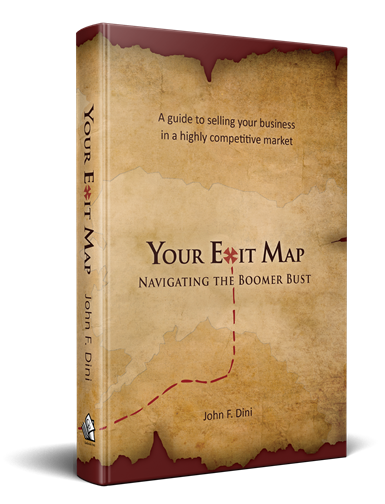

How prepared are you to exit your company?

The Assessment breaks down the four major categories of exit readiness; Finance, Planning, Operations and Revenue/Profit.
Tag Archives: business ownership
The Return of “Do It Yourself”
For the last 40 years, America has been on a roll. Baby Boomers, raised in a competitive environment, have increased the average work week, made the two income household ubiquitous, and currently operate about 60% of the small businesses in … Continue reading
6 Responses to The Return of “Do It Yourself”
Leave a Reply
Can Small Business Survive Federal Regulation?
It has always been tough to start a business, but as Niall Ferguson points out in his excellent article “How America Lost Its Way” in the Wall Street Journal, it’s getting tougher. According to an annual survey by the World Bank, in only … Continue reading
2 Responses to Can Small Business Survive Federal Regulation?
-
Totally agree with the criminal background check. not just a right but practically a necessity. who would want to hire an embezzler to be your accountant, right? we get to check everything else on a resume’ or application, but not whether they broke the law? By the time an employer does the background check they have already passed the point of a judgement based on color, race, etc if in fact they were narrow minded enough to allow that to enter into their hiring decision.
Disagree on healthcare. everyone deserves it and while the current law sucks it was the best our representatives could come up with considering their primary objective is always political, not about the people they represent. A lot of great ideas were shot down based solely on rhetoric, unsupported assumptions and lies as facts. (BTW, i pay 90% of my employees’ healthcare)
Leave a Reply
Can Franchising Survive The Baby Boomers?
As a consultant to business owners, this is a column I’ve hesitated to write for a long time. There are over 800,000 franchised businesses in the United States, and I’m not going out of my way to make that many owners mad … Continue reading
One Response to Can Franchising Survive The Baby Boomers?
-
This is a WAKE UP CALL. I had never thought about the vulnerability of the franchise industry to the demise of the boomer generation. I have to sit back and think about this. My focus has been on the impact that the boomers will have on the succession plans for independent financial planners, wealth manager and insurance agents. Just like your food and hotel franchise examples, these individuals poured their lives into building profitable practices and it is unlikely that the next generation has the motivation to continue the growth of the industry. For more than a year we have been in conversations with large corporations that provide regulatory compliance and package insurance products to support these aging entrepreneurs. The companies are finally recognizing the imapact of the loss of their top producers. I will use this franchise analogy to paint the picture for them. Thank you.
Leave a Reply
Over Pay or Over Hire?
Many employers chase the Holy Grail of pay-for-performance. Whether it’s commission, piece work or production bonuses, we all want a system that compensates employees appropriately for the value they add to our business. Most of us also believe that better employees … Continue reading
2 Responses to Over Pay or Over Hire?
-
Amen, “pay for performance” I often cited as a panacea for improving business performance, or worst yet, a “best practice” we all should adopt. It makes me want to throw up! There is no substitute for engaged management, but I do have to admit that “pay for performance” does require management to establish operational metrics and when an owner manager puts his own money on the line, he does tend to be engaged.
Those of us aware of the 1920’s experiment at the Bell Labs Hawthorn plant should recall that the study showed us that productivity improves when management has key metrics to measure output and is engaged with the productivity. Out of this study, we learned (or should have learned) that there is no substitute for management paying attention to positive results – Results have to be measured and it takes metrics to measure results – Amen.
Proponents of the virtues of “pay for performance” often cite numerous success stories of businesses that thrive with a culture using these tools. However, consider, is there causation or a correlation between such performance. In other words, do the businesses that are performing well do so because their compensation formula is some incentive plan, or because the business is among the larger population of strong businesses that have ENGAGED management with METRICS – AMEN. -
Another excellent post, John! Thank you
Leave a Reply
Can Your Small Business Survive Disaster?
Memorial Day weekend served up numerous reminders of the vulnerability of small businesses to disasters. Boardwalk vendors were reopening on the Jersey Shore and Coney Island. San Antonio was underwater, and a large portion of Moore, Oklahoma was swept away … Continue reading
John, I appreciate your articles and I often agree with you on many of your assertions. On this topic though, I must introduce an alternative not in sync with yours. That is … when the egg’s not frying fast enough … often the solution is to turn up the heat.
You are correct that time is a limited commodity. And you are also correct observing that many individuals identify their own success “by position and consumption.”
But comparing the priorities of the sub-40 generations with those of the “boomers” today is not a reasonable comparison. The “right” comparison would be to compare the sub-40’s to the “boomers” when they were sub-40. Individuals younger than 40 will naturally have different priorities at this earlier stage of their life than a “boomer” does now. Who’s to say that at 45 to 55 those sub-40’s won’t decide to “turn up the heat?”
I agree that there a differences in generations. But sometimes differences have more to do with stage of development than with the constraints imposed by the arbitrary age cut-offs required of generational labels. What may be more accurate is that, to some degree, we all define ourselves “by position and consumption,” and when one’s actual circumstance does not reconcile with one’s desired level of position or consumption, that dissonance can create a sense of urgency to move closer to accordance. In response to the dissonance, some will choose to “turn up the heat” while others will simply adjust their self-definition.
I suspect that every generation will contain an ample cohort of individuals who will not be satisfied until there is a good fit between their own wants and needs, and their ability to satisfy those wants and needs. It may even be true that given the opportunity that the “boomer bust” creates, the “sub-40’s” will elect to “turn up the heat” a little earlier to seize the unique opportunity presented to them.
Thanks again for your thought provoking articles John.
Mike
John:
Good, thought-provoking article! Given the fact that Gen Xers and Millennials prefer to “work to live,” I wonder if another reason Boomer business owners continue to work long hours is because they feel there’s no one else who can manage their businesses as well as they do. Do you think the Boomers have done a good job finding and cultivating the right talent to take over for them one day?
Rob K. – MillennialEdge360
in your last paragraph you say that GenXers “better learn how to hammer a nail” as their reduced productivity will cause them reduced disposable income. That warning is looking at the world from a Boomer perspective. When i talk to my GenXer kids and their friends, they’re quite willing to live on reduced disposable income – they have no desire to “judge their success by position and consumption”. My (Boomer) initial reaction is to try to talk sense into them; but them i think about it more and say – maybe you’re right. Take that year sabbatical at age 28 and go to Spain with your girlfriend. The rat race will be here when you get back!
Thanks again John, spot on, thought provoking as usual. To Rob’s comment on cultivating the right talent, it is difficult to find the margins to hire two people for a job that used to take one passionate employee, the exception being a family owned business, where the children are vested at an early age and actively engage on their own.
While I’m no coach, so therefore, don’t have the broad background you have, my experience in working with Millennials is that they’ve learned lessons from their parents quite well, thank you very much.
The small group of entrepreneurs I’m working with now are looking at leverage, from every angle. Several want the material trappings Boomers are noted for, yet I agree, they don’t want to work the long hours they saw (and many still do see) their folks put in every week.
So they’re finding ways of creating passive revenue, at every turn. While they’re willing to put the time and energy in getting something off the ground, their overriding goal is to have others do the work, so they can do something else. (I’m assuming they’re starting other ventures for more passive revenue streams. But you know what they say about assume!)
So what do they do? They follow in their parents’ footsteps: They outsource, both stateside and overseas. There are still plenty of other millennials who are willing to put in the long hours, and this group of millennials I’m working with are happy to leverage that.
They’re also leveraging their outsourcing efforts, too. Because they’ve watched their Boomer parents’ loyalty get in their way of profitability and progress, they’re not overly tied to one vendor. So they find a few who will do the same tasks. If one rises to the top, they’ll outsource more to that individual or organization, but not all of it. From what I’m seeing, they’re not putting all their eggs in one basket.
Yes, they’re more group-minded, but they’re also very bottom-line driven. And if something’s not working, they’re willing to pull the plug faster than their elders.
Because not all millennials are like this group of people I’m working with, I think there’ll be plenty of folks who will still be willing to put in the long hours, just because they’re having so much fun doing it. As long as it’s fun, Millennials will play the game. Once it stops, it’s game over — and on to a new one.
Most of my 20-year career as a custom publisher (magazines and newsletters, both electronic and printed) has been spent working with Boomers. As one myself, I understand them, their motivations and how to make them happy. Millennials have opened my eyes to doing business a different way. I find it refreshing to work with and learn from this group of business people.
And if I can get out of my own way and take a page from the millennials’ book, I, too, may just find myself with a nice passive income stream. Until then, though, the 40+ hour work week beckons…
Interesting and thought provoking article. I think that Baby Boomers are doing something very different than our parent’s generation. When my dad was my age his career was on a path that he stayed on until his retirement. My friends and I have cobbled out careers that have spiraled and shifted based on changes in the marketplace and changes in employer/employee relationships. Those of us no longer in the traditional workplace find ourselves at a new frontier and work relationships are like a circling of wagons to be better able to get to the new world. Though there is more DIY, there is also much more ad hoc team building driven by what works. I haven’t quite figured out how to not work long hours, though…