
-

As a business owner, you know what it’s like to lie awake at 2 a.m. Maybe it has happened when you are excited and full of new ideas for your business. More often, it’s because you are worried about issues you will face the next day. Sometimes, it’s because you just woke up with the solution to a problem. I’ve experienced all those emotions about my businesses over the years. Awake at 2 o’clock? is where I share them with you, and hopefully help with answers that will let you sleep.
 John F. Dini


-
Your business is your life’s work. What comes next?
Your Exit Map: Navigating the Boomer Bust, combines humor and real owner stories, to help you understand your exit options, protect what you’ve built, and plan your next chapter.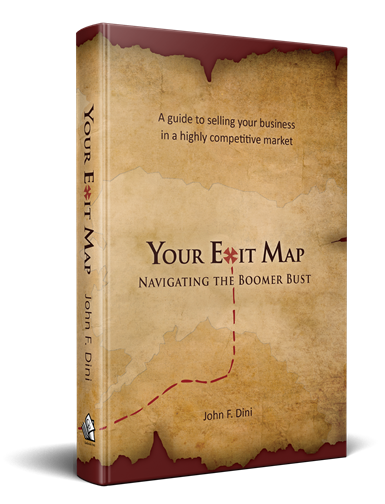

How prepared are you to exit your company?

The Assessment breaks down the four major categories of exit readiness; Finance, Planning, Operations and Revenue/Profit.
Tag Archives: business ownership
Employees aren’t Partners
Many of my clients are recovering from the recession. They are running lean, and have restored their profitability, even if at lower revenues than prior to 2008. Those that had to reduce or freeze employee compensation are seeking ways to … Continue reading
3 Responses to Employees aren’t Partners
Leave a Reply
A Return to the Handshake?
There are five words that strike fear into the heart of every business owner. They are “Let me call my lawyer.” I’m not talking about threats. If I had a nickel for every person who threatens “I’m going to call … Continue reading
2 Responses to A Return to the Handshake?
-
Well said! I can’t tell you how many times I’ve let people know that my handshake is my contract and my work is my signature.
-
I agree. A clear statement of what we both agree needs to be accomplished is great. I find an hourly rate with a guess as to how many hours works well. It allows you to change the scope without anyone getting concerned. It protects the provider and assuming the consultant does not draw things out, usually the client gets the project cheaper because no fudge factors are added into the price to cover the unexpected.
Leave a Reply
The Seven Questions of Simple Planning
The Creation In the beginning was the plan And it sprang from the assumptions And the assumptions were without form So the plan was void of substance And darkness fell upon the face of the workers And the workers … Continue reading
One Response to The Seven Questions of Simple Planning
-
Excellent advice, John. I offer my clients a less rigorous first step, not nearly as good as yours. It too is designed to get their toe in the water, in hopes they will engage in the process and expand upon it. On one page they list the two or three most important accomplishments for the year; then the two or three shortfalls for the year; then the two or three most important goals for the upcoming year.
Leave a Reply
Getting Smart about SMART
It is approaching 2012, and (hopefully) most of us are finalizing our plans for the upcoming year. In our groups of The Alternative Board, we are asking each member to state their sales and revenue objectives. We all know that … Continue reading
Leave a Reply
Thanks for Everything
A British friend was commenting to me on how “odd” he found the American celebration of Thanksgiving. “There is no equivalent holiday in Europe, or anywhere else in the world.” he said. “You have an entire day devoted to conspicuous … Continue reading
This is an excellent article and I completely agree with the concept that only Exectuive Mgmt should profit share. Incentive based pay for the employees is a good practice, but needs to have flexibility to ebb and flow with the needs of the business being met first and foremost.
John, I disagree. I used profit sharing with my employees for 15 years. Each employee in my company contributed to the profits of the company. We were a maufacturing company and everyone contributed, not just the managers. We did set up a system whereby each employee’s share of the profit was based on compensation, years of service, and a performance factor. We met monthly with all employees and reviewed our financials with them. They knew where they could help by controlling expenses and where they could cut costs. they knew the cost of the materials that they were using in the process and could increase the yield and productivity of the operation. When the company was sold the employees were given over $500,000 to be dived up according to the previous criteria. After 25 years they are still there.
That sounds lile a great system, Larry. I note you said “performance” was a key criteria. I have absolutely no problem with using company profitability as a funding scale for incentive programs. My piece criticised companies that distribute profits as an entitlement, without defining what individuals need to do to earn their share.