
-

As a business owner, you know what it’s like to lie awake at 2 a.m. Maybe it has happened when you are excited and full of new ideas for your business. More often, it’s because you are worried about issues you will face the next day. Sometimes, it’s because you just woke up with the solution to a problem. I’ve experienced all those emotions about my businesses over the years. Awake at 2 o’clock? is where I share them with you, and hopefully help with answers that will let you sleep.
 John F. Dini


-
Your business is your life’s work. What comes next?
Your Exit Map: Navigating the Boomer Bust, combines humor and real owner stories, to help you understand your exit options, protect what you’ve built, and plan your next chapter.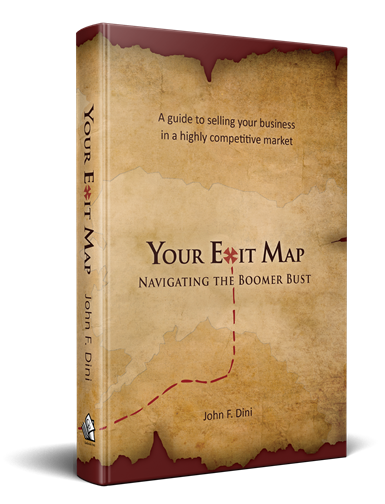

How prepared are you to exit your company?

The Assessment breaks down the four major categories of exit readiness; Finance, Planning, Operations and Revenue/Profit.
Tag Archives: small business advice
Over Pay or Over Hire?
Many employers chase the Holy Grail of pay-for-performance. Whether it’s commission, piece work or production bonuses, we all want a system that compensates employees appropriately for the value they add to our business. Most of us also believe that better employees … Continue reading
2 Responses to Over Pay or Over Hire?
Leave a Reply
Can Your Small Business Survive Disaster?
Memorial Day weekend served up numerous reminders of the vulnerability of small businesses to disasters. Boardwalk vendors were reopening on the Jersey Shore and Coney Island. San Antonio was underwater, and a large portion of Moore, Oklahoma was swept away … Continue reading
Leave a Reply
Is “Follow Your Passion” Really Bad Advice?
It’s graduation season, and honored guests clutching honorary degrees are speechifying at commencements all around the country. In a recent story on National Public Radio, quotes from celebrities including Ellen DeGeneres, Oprah Winfrey and Michael Bloomberg all included the same … Continue reading
5 Responses to Is “Follow Your Passion” Really Bad Advice?
-
Brilliantly put. It is exactly the same in the UK. Graduates with no experience of the real world assuming because they have a degree employers will welcome them and throw money at them. We have all time highs in numbers of graduates but the majority of degrees are in media studies and the like that are of little use to the average SME who will have to invest considerable sums of money to train them and educate them in what business really needs.
We have the same ‘Follow Your Passion’ message across here and a dumbing down of standards where school children and college graduates are not allowed to fail. They have no idea what failure means or how to deal with it and are now facing it. Many sadly are being woken up with a jolt and big debts for a degree that isn’t worth anything.
On top of that many SME’s and bigger businesses have job vacancies we can’t fill because the applicants have little to offer and expect too much. -
I need to take a deep breath before replying because there is some truth in what your are saying, but there is also fault to the logic. It might just be the title that rubs me wrong.
We have had trouble hiring recently. There are literally a hundred or more applicants for each position, and few are actually qualified. However, these aren’t even for entry level jobs – we are requiring a minimum of 3-5 years of experience for most positions, and they STILL aren’t qualified. I think that this is because most SMBs can’t or don’t provide proper entry level training. My own management team even came to the realization that we were not in a position to hire recent grads, due to a combination of our lack of internal training resources and the cost/lack of availability of those resources externally. So my business is admittedly perpetuating the problem. So on the point at colleges aren’t preparing students adequately, I agree, but I think both colleges and businesses need to adjust.
Now on to the point about passion. When I was headed to college, my dad pulled me aside and asked what I wanted to study. A straight A student, I replied, “a doctor or lawyer, and I’m leaning toward law.” I’ve never seen such a look of disappointment on his face. To everyone, including myself, I was an artist. I had always loved art and excelled at it in school and in competitions. He asked why I didn’t plan on studying art and my response what that my art teachers warned us not to wind up as “starving artists”. One of my favorite teachers recommended that I study business if I wanted to be an artist. My dad was then disappointed in my teachers and mentors. He hauled me over to the early-stage dial up Internet access that we had at home and managed to find a really cool chart showing income ranges for various professions. He showed me very wealthy and very poor salaries for each position. And then he asked, “where are you going to fall on this spectrum if you are doodling in the margins of your law books? Are you going to be one of the greatest lawyers?” He was right. I was meant to study art. I have an older brother who is a journalist. We have both “made it” in or professions and are at the top of our income categories, and I am thankful to my father for being so supportive of our dreams.
I don’t believe that passion and entry level job preparedness should be inextricably linked in this discussion. I can’t give up on the idea of self-actualization, but maybe those dreams do need to be tempered with encouragement to pursue a double major or minor in something that will help with the first few years out of college. If I had received a business degree, it certainly would have made entry level job searches less painful, and would have benefitted me in my role as a business owner. Maybe in 1996 that wasn’t as crucial as today. I think the caution is: let’s not overly stifle the passions of an entire generation and wind up with a well-trained entry level, and later, horribly mediocre working class.
-
I encouraged both of my children to find work they were passionate about. Both found desired career paths in their senior year of high school, both went on to college and graduated within their chose fields. My Occupational Therapist, immediately employed after college worked two different positions (clinic based & home health) prior to finding, four years and a marriage later, her passion as a neo-natal OT. My Film Editor, living at home worked contract jobs throughout Texas, worked in a warehouse, odd jobs and faithfully made monthly payments on his student loans, while living at home. Two years & 5 months elapsed until he found a full time editing position.
My point in all this is following a passion has to be balanced/realistic and adaptive. Following one’s passion is not bad advice. It just needs to be balanced with the individual’s commitment (true passion, not a passing fancy) and their resources to stay the course and adapt.
-
A wise man once said “I think owning a business is the most interesting thing you can do.” That sounds like passion to me. As does “Awake at two o’clock.” And since when is entrepreneurship a profession with a strong, predictable income stream? Sounds like lots of people following their passions.
Leave a Reply
Boomer Business Owners’ Retirement Accelerates
Pepperdine University, in cooperation with the International Business Brokers Association and the M&A Source, publishes a quarterly Market Pulse Survey on the sale of small businesses in the United States. The most recent report, covering the fourth quarter of 2012, … Continue reading
3 Responses to Boomer Business Owners’ Retirement Accelerates
-
I don’t stay in the usa but I agree with you on the matter their is a big differ from.genx and the land wil provide a harder operation to the genx than before or ever
-
Great post — as per normal — thanks John.
I am intrigued by your “Woodstock” password. Is this a reference to Snoopy’s indefatigable secretary? Or to your misty memories of a certain festival in the ’60s?
I think we should be told…….
Leave a Reply
Three Rules for Small Business
A few days ago a discussion on LinkedIn’s “Small Business Accelerator” group asked “What are the three things a small business owner should focus on?” As challenging as any business is, the basics remain the same for everyone. We provide goods or services, … Continue reading
One Response to Three Rules for Small Business
-
John, The beauty of this article is its simplicity. Rule #3 is of particular interest to me because I recommend another simple tactic that helps in identifying the priority of actions to improve the generation of profit. I am referring to the 80/20 Pareto Principle that approximates to “80% of your profit comes from 20% of your customers” or “80% of your costs come from 20% of your operations.” This is an oversimplification but applying the thought process across a company does reveal where to apply resources. Richard Koch’s book The 80/20 Principle is the reference work on the subject.
Another comment is more controversial. I like to see business owners measure the value that they are creating in their company and track its change year over year. This is preparation for the day when they will depart, but it is also a check on the health of the company and the industry it is in. The measurement includes a standardized process of a three year forward projection and calculation of the Net Present Value of the cash flow, plus a simple terminal valuation at the end of the third year, discounted to the present. If this valuation is growing, the owner has added comfort in his/her commitment to the company and supports making suitable investments. If it is declining, it is time for a serious look at future plans.
Amen, “pay for performance” I often cited as a panacea for improving business performance, or worst yet, a “best practice” we all should adopt. It makes me want to throw up! There is no substitute for engaged management, but I do have to admit that “pay for performance” does require management to establish operational metrics and when an owner manager puts his own money on the line, he does tend to be engaged.
Those of us aware of the 1920’s experiment at the Bell Labs Hawthorn plant should recall that the study showed us that productivity improves when management has key metrics to measure output and is engaged with the productivity. Out of this study, we learned (or should have learned) that there is no substitute for management paying attention to positive results – Results have to be measured and it takes metrics to measure results – Amen.
Proponents of the virtues of “pay for performance” often cite numerous success stories of businesses that thrive with a culture using these tools. However, consider, is there causation or a correlation between such performance. In other words, do the businesses that are performing well do so because their compensation formula is some incentive plan, or because the business is among the larger population of strong businesses that have ENGAGED management with METRICS – AMEN.
Another excellent post, John! Thank you