
-

As a business owner, you know what it’s like to lie awake at 2 a.m. Maybe it has happened when you are excited and full of new ideas for your business. More often, it’s because you are worried about issues you will face the next day. Sometimes, it’s because you just woke up with the solution to a problem. I’ve experienced all those emotions about my businesses over the years. Awake at 2 o’clock? is where I share them with you, and hopefully help with answers that will let you sleep.
 John F. Dini


-
Your business is your life’s work. What comes next?
Your Exit Map: Navigating the Boomer Bust, combines humor and real owner stories, to help you understand your exit options, protect what you’ve built, and plan your next chapter.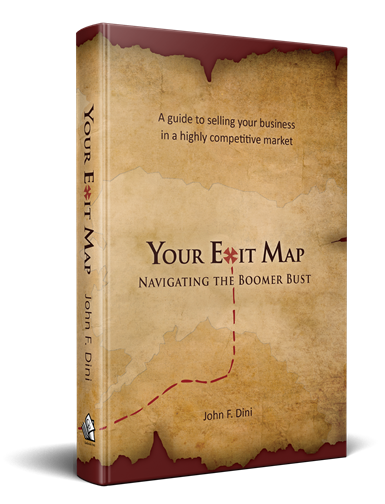

How prepared are you to exit your company?
The Assessment breaks down the four major categories of exit readiness; Finance, Planning, Operations and Revenue/Profit.
Tag Archives: small business advice
The Migration from Service to Knowledge
As I have pointed out frequently in this space, the Baby Boomers’ entry into entrepreneurial business moved the core of the American economy from products to services. (see www.theboomerbust.com) Multiple dynamics created the shift. Boomers were degreed at four times the … Continue reading
Leave a Reply
Who’s Picking Up the Tab?
When a small business is sold, the total price of the business includes not only the cash paid, but any obligations assumed by the buyer on behalf of the seller. Transfer of a loan balance, accrued vacation pay for employees or … Continue reading
Leave a Reply
The Disconnect Between Skills and Jobs
A Gallup/Lumina Foundation Poll released a few weeks ago is getting attention in the business community. In a survey of 623 business leaders, most said that higher education was important, but where an employee earned a degree, and what the degree … Continue reading
3 Responses to The Disconnect Between Skills and Jobs
Leave a Reply
Empowerment Requires Encouragement
We all want employees who are empowered to think. That doesn’t always turn out the way we hoped. Last week the news feeds carried a story about a Girl Scout in San Francisco who set up her cookie table in front … Continue reading
2 Responses to Empowerment Requires Encouragement
-
Hi John,
I think few business owners would call micromanagement a good thing, if you put it in those terms. The trouble is finding the balance between delegation that keeps your business strong and creates a product you can continue to be proud of and realizing that all of this does require some amount of letting go. I’ve left this comment over in the BizSugar community as well where Christi Brendlinger was good enough to share this post. Wonder if you or she or both could share some guidelines with our community about exactly how you go about striking this difficult balance.
Leave a Reply
What Price Sochi?
In business, there is a danger that a big new project, landing a giant customer, or an unexpected personal event will draw your attention away from the job of running your business. When an owner is the driving force behind day to … Continue reading
I am also aware that a very large nimber of successful companies are started by people that have no particular education but have a belief in themselves and their abilities and go ahead in the wider marketplace in spite of ” no education” . In fact in my experience I have seen may qualified people totally able to think productively for themselves. I have also seen many untrained and uneducated personal really achive if given the right support and oportunity. I therefor do not believe there is a hard and fast rule but a need to really have a very good look at what is wanted and expected and chose the right cloth for the right suit and not just stick to one size fits all.
Further to this is that I think that the young are sold the idea that a education is going to give them the right to a job of their wish and a good education will gaurentee a salary to suit. However there are not enough positions available any longer as the world become increasingly more crowded with quailfied graduates , less jobs and more automation.
Given this situation the responsibilty of choosing the right person it is becoming more clouded.
It sure would be a step in the right direction, if the Public Colleges would direct our tax payers $$ into degrees programs for which there are jobs, and reduce the $$ in degrees programs for which there are few jobs. Just like a business they should try to created an inventory of graduates that can be sold, make a good living, pay taxes, and donate back to their college. If someone wants to study in field in which their are few jobs, let then go to a private college. We do not need to be using our tax $$$ educating citizens into a field which there are no jobs.
Great point Mike. You’re saying that public funds should be focused on helping to promote the general welfare. Just seems to make sense.