
-

As a business owner, you know what it’s like to lie awake at 2 a.m. Maybe it has happened when you are excited and full of new ideas for your business. More often, it’s because you are worried about issues you will face the next day. Sometimes, it’s because you just woke up with the solution to a problem. I’ve experienced all those emotions about my businesses over the years. Awake at 2 o’clock? is where I share them with you, and hopefully help with answers that will let you sleep.
 John F. Dini


-
Your business is your life’s work. What comes next?
Your Exit Map: Navigating the Boomer Bust, combines humor and real owner stories, to help you understand your exit options, protect what you’ve built, and plan your next chapter.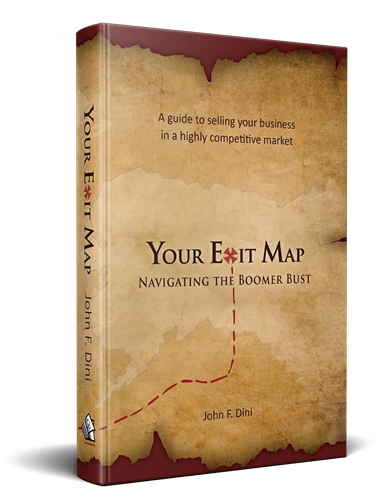

How prepared are you to exit your company?
The Assessment breaks down the four major categories of exit readiness; Finance, Planning, Operations and Revenue/Profit.
Tag Archives: small business
“Everyone has Gotten So Rude!”
Not too long ago, I was leading a group of business owners in a discussion. These were not my peer board members, but rather owners at a breakfast, none of whom I’d met before. To start the conversation, I asked … Continue reading
6 Responses to “Everyone has Gotten So Rude!”
Leave a Reply
Five Steps to Defining an Employee’s Authority
When we delegate authority to an employee, we are actually delegating the power to make decisions. We all want employees who think for themselves, at least when their decisions work out in a way we like. When they don’t, we … Continue reading
Leave a Reply
Do Titles Make Leaders?
You’ve promoted a great employee beyond his capabilities. He is putting in long hours, but appears unable to keep up with the new responsibilities. In fact, he doesn’t even seem to understand what those responsibilities are, or what they should … Continue reading
Leave a Reply
Do Leaders Need Titles?
When should an employee be promoted? Over the years, I’ve often had this conversation both within my own companies and with owner-clients. An employee is handling responsibilities above his or her official job description. We naturally want to acknowledge the effort, … Continue reading
4 Responses to Do Leaders Need Titles?
-
Great post John:
I fully agree, Promotions are much better received when they are “earned” in the hearts and minds of the peers. Although, this can’t always be the case; it is ideal whenever possible.
Far too many times in the corporate world I have seen promotions given that were not deserved; ultimately demoralizing key members of the organization.
-
From my experience a title and $5.95 will get you a cup of coffee at Starbucks. A leader creates an emotional link with his workplace team and excels without a change in business cards.
-
i agree mostly, John, but where I disagree is where an inappropriate title and/or job spec leads others in the organization to resist and even undermine the efforts of a leader to the point of doing damage. Good Leadership qualities will generally motivate the team and help them see the virtues of the results being sought, but in most organizations, there are those who refuse to see the light and are only interested in protecting their turf and “superior” level in the organization. An appropriate title and job spec makes the role of the leader clear to all.
-
Great post and great discussion.
Shows it not such an easy decision. Different things motivate different people – some the title, some the money and some probably all the recognition
Leave a Reply
Iron Rice Bowls and the Impact of Government Funding
There was an interesting editorial item in The Economist that unintentionally says a lot about the impact of government intervention on industry. In the last generation, the average number of working hours needed to purchase an automobile, clothing or other … Continue reading
8 Responses to Iron Rice Bowls and the Impact of Government Funding
-
We must never let our guard down.
-
While I completely concur with the article with respect to education and housing, healthcare is a different beast entirely. The United States has by far the least efficient healthcare system of any developed country because of a deficiency of government involvement, not an over-abundance of it.
By depending on a vastly greater level of market-based forces, instead of control, the U.S. has created a monster. This is because healthcare by definition does not work on market principles. When any individual’s health is at stake they do not care what it costs, they just want to be treated. That means the suppliers have total coercive control over the “market”.
Can anything realistically be called a market when it a) is difficult or impossible to even determine what a product costs before it is purchased; and b) there is not really choice about whether it should be purchased? Do you operate that way in any other aspect of your life?
U.S. healthcare has evolved to a level of insanity beyond what even a pure market system might produce. The stakeholders: people, providers, insurers, employers, state government and the federal government all have competing interests. The result is that if you are lucky in terms of employment, insurance, income and location, you might get absolutely world class healthcare. If not, you might get none at all. Meanwhile the entire system thrashes against itself creating unbelievable inefficiency and overhead, resulting in costs 3 to 4 times higher than necessary. Small example: our local hospital system has 12 executives making over a million a year.
ANY other business operating this way would have been bankrupt a very long time ago. Some things should not be market driven. I submit access to roads, clean water and healthcare for starters.
I would say, “Don’t get me started. . . .” but too late for that.
-
To take the average working hours concept a step further: (1) the average working hours to purchase an automobile has decreased, yet vehicles haven’t remained static — they’re loaded with many more safety, comfort, and entertainment features today than ever before; (2) a student leaves school with about the same amount of basic knowledge today compared to say the ’70s or ’80s and pays considerably more.
-
Sadly, your response is entirely correct.
-
Thanks for introducing me to the Iron Rice Bowl concept. You guys in the beltway and Washington DC area, it is time to listen up!
When will we bring back an objective money standard, i.e., gold or silver?
It is true that we don’t see cold call sales people, but we do try to treat them courteously.
Interesting and so true. The World has changed! When I started in sales in 1979, I use to park my car in an industrial area, and walk the block making cold calls. I do not believe that would work in today’s world.
Just like a lot of us grew up with an open chain link fence or no fence at all. We all knew our neighbors.
Today most fences are tall wooded structures that are not open to your neighbors to see in, and a lot of us never see or know our neighbors.
I agree that most of my calls today are “warm calls”. Either the customer found us on the web and ask to see us, or I connect with a referral or follow up from a show.
However I do miss the FUN of making cold calls. Use to learn a lot about an area and meet new and interesting people.
Mike
.
I began selling in 1964. From day #1 – based on the sales book used at my Monsanto sales training course, “How I Raised Myself from Failure to Success in Sales” by Frank Bettger – I always worked by appointment out of respect for the other person’s time. I felt that just “dropping by” suggested that the CEO or Purchasing Agent had little to do besides entertain me.
That said, when I would call for appointments, I usually got a somewhat friendly reception and an appointment.
In 1975 I changed to selling estate planning/financial planning just like your subject in your opening story. We called on business owners – valuable, illiquid assets like a business need cash, i.e. insurance, to pay estate taxes at death. WHen I made that switch, also moving to New England from the Midwest at the time, I found an ENTIRELY different atmosphere – hostile, suspicious, defensive, closed off.
Since then it’s only gotten worse. Coward that I am, I now employ a telemarketer to “sell” initial telephone consultations. Easier appointment to get, somewhat less productive than face-to-face.
As pointed out, the Internet has changed so much. It used to be that sales calls were an important source of information. Now we are constantly bombarded with information, and the challenge is on filtering most of it out. Which comes across as abrupt or rude. We have been trained the we can search for what we need when we need it. Knowing exactly what we are looking for has become the challenge.
Our distribution business requires cold calling. We get no where with phone calls and little with emails, so we go to the prospects. In food service this has not become entirely unexpected. We apologize for interrupting, introduce ourselves, leave a card, ask for a card and a future appointment. Rarely are we treated poorly and the results are still worthwhile.
I agree, Jeff. The restaurant industry – perhaps due to the more hectic nature of mealtime rush and lulls combined with the “hospitality” aspect of greeting everyone as a potential customer, is one of those where cold calling is still effective and expected.