Is It All About the Money?

If you have more than ten employees, and an outside observer (like me) asks them confidentially to say in one word what their boss cares about the most, what do you think they will answer?

We’d like to think that answer will be “quality.” Or perhaps you might prefer “service,” or “customers,” or “employees” or “vision” or “culture.”

I often get the opportunity to ask that question indirectly because I coach the owner of a company, but in many cases may also be teaching a management class or leading a key executive group with his or her employees. Do you know what they think the answer is? “Money.”

I know very few business owners whose first concern is money. They aren’t fixated on it, but it just seems to always be the topic of conversations with employees. Take this conversation between an owner and a manager last week (slightly disguised for anonymity).

Q: “Why didn’t you get the compliance reports done for the last two operating periods?”

A: “I was covering shifts for an employee who called in sick.”

Q: “Why didn’t you bring in an on-call person?”

A: “No one wanted to do it for $10 an hour.”

Q:” Why didn’t you offer more?”

A: “Because that job pays $10 an hour.”

Q: “But when you are doing it, I’m paying you $24 an hour, and the compliance work isn’t getting done. Wouldn’t offering $12 or even $15 an hour to someone have made more sense?”

A: ” I thought you said that taking care of the customer came before anything else.”
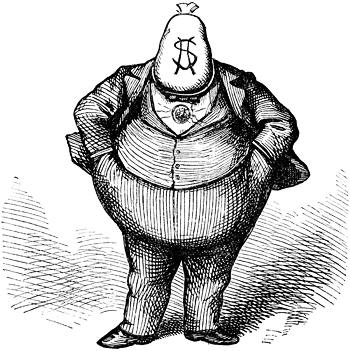
It’s two different conversations. The employee is pleading that his priority is service. The boss isn’t disagreeing, but is pointing out that the delivery method chosen wasn’t cost effective. The employee only hears “money,” which in his mind is mutually exclusive with service.

The perceived conflict exists in most businesses.  For the owner, taking care of the customer is of primary importance. He also realizes that he can’t take care of customers (or employees for that matter) for very long if he is losing money on each transaction.

It happens at every level. A master’s degreed employee recently told me “The boss says he can’t afford to have me wasting non-billable hours on side projects. I get paid $60 an hour. When he bills for me, it is at $150 an hour. I could be unbilled for two days every week and he’d still be fine. He just wants to make as much as he can.”

Actually, after overhead and benefits, if the employees were unbilled for even one day a week the company would quickly be out of business. The effort of explaining the cost dynamics of the business, employee by employee, month after month, is too exhausting for most employers.

So we resort to shorthand, telling them just what they need to know. “If we don’t get revenues up, there will be no raises.” “We have to cut expenses, we aren’t making a decent profit.” “We have to get higher margins.” We have to work smarter, because we can’t afford to hire more people.”

The employees hear you, and think “All he cares about is the money.”

I’m not Pollyanna. I don’t believe that the employees would understand a whole lot better if we had weekly meetings where we only talked about quality and service, and never mentioned profit. On the other hand, the companies who say that they just focus on doing the job right and let profits take care of themselves are frequently, although not always, short-lived.

This is more of a reminder. We need to talk to employees about costs and profits, but we also need to talk about why and how those fit with the rest of our vision for the business.


Posted in Leadership, Management | Tagged , , , | Leave a comment

Leave a Reply

Your email address will not be published. Required fields are marked *

An Army of One

Hollywood has done an excellent job of defining what it takes to be an action hero. George Smiley, the grey civil servant of John Le Carre’s spy novels, is a protagonist, but not a hero. Heroes are cast in a distinct behavioral pattern. Bruce Willis, Mel Gibson, and Harrison Ford characters represent the archetype I’m describing.

We use the DISC behavioral profiles with all of our clients. Perhaps we shouldn’t be surprised that the factors that make a Hollywood hero also appear in many of the business owners we work with. The question is; do Hollywood action heroes make good entrepreneurs? Consider the action hero behavioral profile.

High D. The high Dominant personality solves challenges by overcoming them, as opposed to circumnavigation. A high-D entrepreneur takes things head on, and seeks immediate results. Action is usually more important than direction. Think about Harrison Ford’s Indiana Jones. When told that the Ark of the Covenant is on a truck to Cairo, he grabs a horse. Is that the best plan for catching a truck? Probably not, but it is the first action available.

High I. The high Influencer uses language and verbal communication to influence those around him. John McClane, the cop from Die Hard, never shuts up. He rails at the cops, at the villain, at himself, and even maintains a running commentary while he is fighting for his life with the bad guys.

Low S. The Steadiness measurement indicates a tendency towards planning, teamwork and supportiveness. Martin Riggs, Mel Gibson’s character in Lethal Weapon, is a typical loner hero. While he has personal loyalty to his partner, that loyalty isn’t sufficient to keep him from getting them both into trouble regularly, something he does without consulting Murtaugh, and often despite his partner’s protestations.

Low C. The Compliance factor relates to how well you follow the rules. The low C hates the rules; they merely handcuff his ability to act. There are hundreds of examples. “You can take my badge, you can take my gun (I have another- which is of course against the rules), you can take me off the case, you can revoke my 00 license to kill, but you can’t stop me from doing what I think I need to do.”

The low-C also refuses to consider risk in his decision process. Consider Han Solo’s response to C3PO’s calculation of the probability of surviving a flight through an asteroid field. “Never tell me the odds.”

Have I described any entrepreneurs that you know? Of course I have. It takes action, focus, fast talking and usually some risky decisions to start a small business. The problem arises when the action hero entrepreneur becomes successful. Taking your organization beyond the “Army of One” phase requires a different set of behaviors. Those who don’t adapt find themselves stuck at their maximum personal capacity, and can’t bring their organizations to the next level.

James Bond will never get M’s job. Han Solo may marry Princess Leia, but he will never sit next to her in planning meetings. At last count, Martin Riggs and John McClane have been stuck at the same detective pay grade for eleven and nineteen years respectively.

In Jim Collin’s Good to Great (in my opinion one of the three best business books ever written), he talks about the level 5 leader. The level 5 goes beyond the cult of personality, leading with a steady hand and singular focus on long term improvement.

That may work in large organizations, but it’s far more difficult in an owner-run small business. When every employee sees the owner each day, he or she has to exhibit substantial charisma and verbal influence. If you want to grow to an organization where the employees perform without seeing you every day, however, you will need to be more than an action hero.


Posted in Entrepreneurship, Leadership | Tagged , , , | 2 Comments

2 Responses to An Army of One

  1. Victor Perlbachs says:

    Good piece. To be successful in the long run, the super hero needs to trust someone to do the day to day planning and keep the business moving forward, while he or she goes on to the next “mission impossible”.

  2. Paul says:

    Having worked in large Multi Nationals in Senior Exec roles through to Pre IPO organisations and now my own start up in the Executive Search Space, I think this article is right to the point, when are putting out grass fires all day it is hard to get time out too look out over the top of the forest, but without this time and time for planning when your baby is going to become a teenager then you will always be a Super Hero which is not necessarily bad if that is what is important to you and you make that your end game.

Leave a Reply

Your email address will not be published. Required fields are marked *

Proactive, Preventative Sales

Sometimes a topic rises to the top of my long list of candidates because it seems to come up repeatedly. It may be a coincidence (probably is), but a single business ownership issue is raised in multiple coaching sessions or Board meetings in a period of days or weeks.

I work on the theory that for every business owner I know who is dealing with an issue, there are three more in my circle who haven’t discussed it, and 300,000 out in the world who are dealing with it as well. So it becomes a topic.

I have several members who are wrestling with personnel changes in a large customer. They are all vendors to businesses that are many times larger than themselves. In a few cases the customer is an 800 pound gorilla- the single largest account in their portfolio. In others it is merely a good account, not a game changer, but certainly not one you’d want to lose.

People change jobs. The myriad of reasons that they do so aren’t important here, let’s just accept that as a fact of life. Unless you are dealing directly owner-to-owner (and sometimes even then), the employee of the customer with whom  you’ve carefully cultivated a relationship will eventually move on.

Sometimes that is positive. One client of mine admits that the bulk of his new business is generated by buyers who have moved to another employer, and come to his company as soon as they are established elsewhere. That’s great, but he also admits that most customer attrition is due to other employees who come into his customer’s organization and reach out to their old vendors. It’s something close to a zero-sum game.

Another client has a product that is frequently enhanced with new features. They work diligently to tell customers about the many things their product can do, and how each improvement fits in with the whole system. Yet they regularly lose customers who move to another product, citing their need for a feature that his product already provides! The information disconnect almost always traces to a change in personnel. The feature or benefit wasn’t needed at the moment of knowledge transfer, and so was lost.

The most obvious preventative for this situation is to build knowledge depth in the customer. When I sold auto parts, I frequently increased my business by having a parts manager move on. He went to a new dealer and remained a customer, but I had made sure that the assistant manager who took his place knew me well, and was happy to do business with me. Paying attention to the second in command was one of my most effective business development techniques.

In a lot of cases, however, the second leaves and you don’t know about it, or the lead person you work with says they will do the training themselves, or they feel they know the product and it isn’t necessary to have someone else up to speed. Then that lead person moves on, and you are left hoping that his or her replacement learns fast.

Every company needs a regular process for stepping into a customer knowledge gap. It starts with regular checks to make certain your contact is in place, and maintaining a record of who your contact’s boss is. When a contact moves on, you should be offering training to a replacement, enhanced support, or even a fill-in temporary if the customer warrants it.

The alternative is to let the customer work through the change on his own. That just puts you on the list of old relationships to be reviewed.

By the way, I’m making one of my regular visits with Jim Blasingame on his  Small Business Advocate radio show tomorrow, 7:00 AM EDT. Listen in!

Posted in Marketing and Sales | Tagged , , | 1 Comment

One Response to Proactive, Preventative Sales

  1. Mike Pattillo says:

    Some excellent points. I can see where I was short-sighted in thinking I was locked into a company, when it was really a personal relationship I had — and when that person left, I was starting all over. Thanks.

Leave a Reply

Your email address will not be published. Required fields are marked *

The Road Less Traveled

Somewhere ages and ages hence:
Two roads diverged in a wood, and I,
I took the one less traveled by,
And that has made all the difference.

Perhaps Robert Frost’s famous poem isn’t a perfect expression of what I am trying to convey, but the idea he expressed has been ingrained in us (the Boomers- I think Maya Angelou has replaced Frost as required poetry reading in schools) enough to serve my point.

Some thousands of business owners have heard my presentation on the inevitable issues of selling Boomer businesses. Hopefully, even more will  hear it in the future. Many have read my column, caught me on the radio, or bought my book on selling a business. Even so, they represent a small fraction of the estimated 6,000,000 Baby Boomer entrepreneurs with employees in the US.

If you are reading this, you are better informed than 99% of your peers. Whether you are a Boomer preparing to exit, or a gen X or Millennial thinking about becoming a business owner, you know more than almost all of your competition.

I can’t do anything about the birthrates of 65 years ago, or of 45 years ago, or of 25 years ago. Neither can you. From 2018 onward we will have a dramatic, decade-long imbalance between 60 somethings and 40-somethings in the workforce. That has implications for the economy, politics and general business, but it will have a special impact on retiring small business owners.

The Boomers will retire. Some have done so already, some will wait for as long as possible, but sooner or later they will all leave their businesses. We’ve discussed how “the curve” of Boomers entering any given age bracket exploded markets in home building, college graduations, franchising, fitness and so much more.

We could expand the discussion to other industries, from motorcycles (Harley-Davidson has been caught without a product for middle-aged Xers) and cars (Ford recently said that they had sold as many retro Mustangs to 55 year olds as that market will absorb), to garden homes and second-career counseling.

America has grown, and 78 million Boomers in  country of 320 million obviously won’t have as much impact as when they were 40% of a country with 190 million people. But it is a generation exceptionally oriented towards being successful, and working very hard to own the material indicators of that success. Their passing will still create huge ripples.

If you’ve read this series, you are armed with knowledge; the realization of an inevitable glut of small business sellers, and the coming shortage of buyers. You understand why the generational traits of Boomer sellers have made many of their businesses undesirable to their prospective buyers. You should also have a pretty good idea of what needs to change in your business, and how to start down the road of making those changes.

But tomorrow your business will still require the same attention that it does today. You will be just as busy, and making long-term changes will be just as easy to postpone until you have “more time.” Investing time, energy and money in a Second-in-Command or a Successor-in-Training is easily left for another day.

A few business owners will choose the road less traveled. They will begin to shift their perspective from the immediate issues of competing in the day-to-day marketplace, and instead start to focus on competing for a successful end game.

Those are the owners who will beat the Boomer Bust.

 (This is the tenth and final installment in a series about “Beating the Boomer Bust.” Previous installments are The Approaching Tidal Wave, The Pig in the Python,  The Brass RingWork-Life Balance, Outsourcing America The X FactorThe Gen X Business Buyer , Beating the Boomer Bust and Choosing a Buyer for Your Business.)

Picture Credit

Posted in Building Value, Entrepreneurship, Exit Planning, Exit Strategies | Tagged , , , | Leave a comment

Leave a Reply

Your email address will not be published. Required fields are marked *

Choosing a Buyer for Your Business

You may be questioning this title. After talking in depth about the shortage of buyers over the next 10 years, the differences in values and work habits of Generation X, and the competition for ambitious people from better financed and better positioned Corporate America, you might consider yourself to be lucky to find any buyer at all.

Certainly luck has something to do with it. Surveyed on a choice between a hypothetical business partner who was skilled, and one who was consistently lucky, the vast majority of experienced business people chose lucky.

But Seneca, the first century Roman philosopher, said “Luck is what happens when preparation meets opportunity.” If you prepare your business for the right seller, the odds of getting lucky will increase exponentially.

Remember, your competition is any other small business owner trying to sell his or her company. Most of them, unfortunately, believe that preparation for a sale consists of calling a broker and waiting for someone to fall in love with their business. We’ve already discussed why that is unlikely to be the case.

For most owners, selling the business will be the biggest single financial transaction of their lives. What if I called you with an opportunity to present your product or service for the biggest sale of your life? You will have an exclusive interview with the CEO of a Fortune 100 company, who is interested in buying as much of what you sell as you can supply. Would you just walk in cold, and hope for the best?

I doubt it. You would research the customer, and determine why he is interested in your product. You would try to find out what he has bought before, and why. You would review his likes and dislikes, and prepare your presentation to appeal to his preferences.

You may not be able to choose your buyer on an individual basis, but you can choose the general characteristics of your buyer, and start tailoring your business now to fit both his and your objectives.

External Sales

The majority of “main street” businesses, those that earn less than $1 million before taxes, expect to sell to a third party. Owners often ask me “What can I do to make my company more saleable?” Than answer is simple. You should do the same things that you should always be doing to make your company successful.

Ask yourself what you would want to see if you were buying your company. If you are a Boomer, especially one who was born before 1960, would you want a business that required long hours, no vacations and little income? Of course not.

Approach your business from a buyer’s perspective. Are employees in place who are dependable, appropriately compensated and happy in their jobs? Do they have clear duties, and documented procedures? Are your management systems well defined? Is your technology current?

These things may sound obvious, but we all slide a bit when everyone just “knows” how to do their job. As entrepreneurs, we become too accustomed to being the font of wisdom. Most of us have little realization of how many things we decide in a day.

I recommend having this tattooed somewhere not too obvious on your body. Perhaps you should do it backwards, so you can read it in the mirror.

The more I work in my business, the less it is worth.”

It isn’t rocket science, nor is it new advice. In the coming competition for buyers, however, it is more important than ever. As Boomers had to compete in school, competed in work, and competed as parents, so they will be forced by their numbers to compete for buyers in selling almost 6,000,000 small businesses.

Internal Sales

Even if you position your business for sale, there will still be a shortage of buyers. Remember, we are only 5 years from when the ratio of retiring-age owners versus buying-age prospects enters the five year dark ages, the worst ratio between the two in history. If you are prepared, you are more likely to get lucky. A better solution, however, might be to eliminate luck as a factor entirely.

Most small companies can be sold to employees, if they have been trained and qualified to run them. (For our purposes, we will assume “employees” to include qualified family members where appropriate.) It usually takes between five and seven years, but there are substantial payoffs.

First, you can dictate your price, within reason. You avoid the adversarial process of an arms-length buyer who low-balls your value, nit-picks over minor faults, or presses you to take onerous terms.

Second, you get to drive the process. With an internal sale, you can be more flexible about when and how you choose to move on. You can even sell and remain in a part time or advisory capacity. After all, you know that the new owner and you will get along.

Perhaps most importantly, you avoid the distraction of the marketing and sale process. The pace of transfer is more relaxed. Both you and your buyer are working side by side to make the company more successful, because you have a common interest in its success.

Most owners raise one of three objections to an employee sale. The most common is “My employees don’t have the money.”

Given time, most businesses with decent (at least $500K) cash flow can be transferred using stock compensation incentives to give the buyer(s) sufficient stake in the company to allow a financed, or leveraged, buyout. While the employees are working to earn their equity, the seller is taking the increased  profits as part of his ownership value.

The second objection is “I don’t want partners. I’m accustomed to making the decisions.”

While it is clearly advisable to help the new owners learn to make good ownership decisions, you don’t have to surrender one bit of control. There are common and easily implemented legal structures that allow you to drive the bus right up until your last day of work .

The third objection is “I don’t have any employees capable of taking over my business.”

Only you can fix that one.

Well, what are you waiting for?

 (This is the ninth installment in a series about “Beating the Boomer Bust.” Previous installments are The Approaching Tidal Wave, The Pig in the Python,  The Brass RingWork-Life Balance, Outsourcing America The X FactorThe Gen X Business Buyer and Beating the Boomer Bust.)

Posted in Exit Planning | Tagged , , , , , | Leave a comment

Leave a Reply

Your email address will not be published. Required fields are marked *