Employee Confidentiality: Circles Within Circles

The father of a friend, a rancher in South Texas, conveys confidential information by preceding it with the following caution.

“Now I’m going to tell you a secret, and you have to swear not to tell another soul. And when you do, you have to make them swear not to tell another soul.”

Keeping confidential information within a company is often a pipe dream. We regularly tell employees of plans and changes that we don’t want to become common knowledge. Yet almost inevitably, another employee will refer to the secret with a knowing wink within a few days.

People tell secrets because they want to feel special. Sharing a confidence serves that need on two levels. First, it says “I am more important than you, because news was shared with me before it was shared with you.” On the second level, they are saying “Our relationship is important to me, and I want you to feel special too.”

After all, what is the point of being special if nobody knows about it?

Sometimes, there is impending news in a company that has to be available to some, but could create huge problems if it were known to all. This is usually game-changing confidential information, such as a planned merger or an impending reduction in force. Key employees need to prepare for the change, but the consequences would be dramatic if the secret became widespread.

You can utilize the psychology of being special by employing what I call concentric circles of information. First, you share the information with a core group of trusted employees. Bring them together for the news. Knowing who else knows is important. They can share the pride of being special. The other people in the group know who else is in on the secret, and know that the others see them on that level as well.

If they feel an absolute need to discuss the news (and they probably will) then they know whom they can safely talk to.

When it becomes time to spread the confidential information more widely, you choose another group for the same process. The second circle is informed as to who is in the first circle (e.g. executives to managers to supervisors.) At each level there is a recognition of the employee’s individual importance, as well as identification of a “safe” group to discuss things with.

The purpose of sharing in concentric circles goes beyond mere information control. As you tell each circle, get their buy-in on the company explanation. They are your advocates when the next circle comes to them with concerns or questions. Let them know it is their role. “When we inform the managers, we will tell them that you already know. They will come to you with questions, and we are depending on you (because you are more special than they are) to support and explain this.”

Sometimes the news is so huge that you can have little hope of it staying within planned bounds for long. In a company of a hundred people, I’ve used the concentric circle method in as little as one day. The 3 executives were informed in the morning, the 5 branch managers in the afternoon, and the 8 supervisors (who were most likely to blab), after the close of the business day. The general announcement was made the next morning. Each group was assembled from our branches at a central location. When they returned to each office, they informed the next level that they needed to attend a special meeting later that day.

It worked. When we made the general announcement (our acquisition), we had multiple advocates in each branch who could say, “Yes, I knew about that (because I was in on the secret). Everything is going to be OK.”


Posted in Leadership, Management | Tagged , , , , , , , , , | Leave a comment

Leave a Reply

Your email address will not be published. Required fields are marked *

Business Value: Do Your Numbers Add Up?

Most small business owners don’t understand how to value their companies. For some, misunderstanding the way that buyers look at the value of your business can be very costly in the long run.

The fourth of our Rights and Obligations of a Business Owner says that you have the right to a company car, travel and other perquisites. However, these come out of your profits, and so out of your pocket, and both you and your spouse are obligated for all of your personal assets to guarantee everything.

Most business owners take advantage of tax laws by giving themselves at least a few benefits deductible as business expenses. Taking a company truck home at night or tacking a family holiday onto a business trip are widely accepted perks of ownership.

Usually, small businesses are organized under IRS rules that allow profits to be passed through to the owner without a separate level of taxation. Lenders recognize this when they rely on an owner’s personal financial statement to determine creditworthiness, and when they require a personal guarantee for a loan. This is their tacit admission that the actual monetary impact of owning the business is frequently more than what is reported on the profits line of its tax return.

Because personal assets underwrite the business, many owners feel that the business should bear as many of the owner’s personal expenses as it can. In lieu of allowances, family members are put on the payroll. Spouses and children receive company cars, with gasoline, insurance and repairs included.

Clothing becomes uniform expense.  I once knew an owner who spent tens of thousands of dollars annually for cowboy boots in exotic leathers, which were then deducted as work shoes.

When it is time to sell the business, valuations are based on a multiple of profits. How can an owner realize the full value of his or her company after years of keeping the profit numbers as low as possible?

If your business is small enough to be purchased by an individual, simple documentation of how you draw value out of the company is often enough. Business brokers will calculate your Seller’s Discretionary Earnings (SDE) as part of their workup for marketing the business. Any savvy buyer can understand that the same or similar benefits will be available to him once he takes ownership.

Larger organizations, however, may not be quite as understanding. If the business is substantial enough to require outside financing, the lender has more stringent rules regarding what can be considered “profit.” You might be able to explain a family member on the payroll, or an extra vehicle. Too many such items though, will make a lender wary of the accuracy of your books.

If your company is large enough to attract a major buyer, like a publicly traded company or a private equity group, they will usually base their valuation strictly on the results reported for tax purposes. Personal expenses cleverly hidden in the operating costs are disregarded in bigger acquisitions.

When you begin to think about selling your business, consider minimizing your personal expenses at least three years before starting the search for a buyer. Showing better profitability may cost you some added taxes in the near term, but getting 3, 4 or 5 times those profits in a sale more than compensates for the short-term sacrifice.

Posted in Entrepreneurship, Exit Planning | Tagged , , , , , , , | 3 Comments

3 Responses to Business Value: Do Your Numbers Add Up?

  1. Jeff Thomas says:

    Jon,
    Where can i find more on SDE evaluation?

    Jeff

    • John F. Dini says:

      Jeff,
      Pratt’s Stats, among others, will show historical and conparative valuations using SDE measures. To calculate your own SDE, I am sending a worksheet I created directly to you.

  2. Larry Amon says:

    John,
    I agree that most business owners take advantage of personal perks while running the business and I think most buyers realize that. When it comes to selling the business I have business owners recast their financials to deduct their perks and add back in a salary for the new owner. It reflects the true value of the company and the buyer can make their decision based on the recast numbers without the tax burden for the owner for the previous three years.
    Larry Amon

Leave a Reply

Your email address will not be published. Required fields are marked *

Atlas Shrugged and the Imperial Presidency

“Atlas Shrugged – Part II” was released on Friday. Those of you who read this column regularly know that I’m a fan of Ayn Rand, although I place myself far short of devout Objectivism. I’ve sported “Who is John Galt?” license plate frames on my cars for years, and given dozens of copies of the book to business colleagues as gifts.

Few of those who receive the book from me actually finish it. I can understand why. It is very long, and it’s shortcomings as a novel become emphasized in film. There are no real subplots, and character development is limited. Pretty much what you see is what you get. The good guys are good and the bad guys are bad, and they all make that plain within a page or so of being introduced.

Part II follows closely on the heels of Part I (2011) so it is a bit jarring to have all the characters and settings change. Not only have Dagney, Francisco, James and Hank aged (all played by different actors) but Wesley Mouch, while still portrayed by someone known for nasty characters (the dependably dislikable Paul McCrane) is a stereotype, but a completely different stereotype. Minor characters like Phillip Rearden, Paul Larkin and Orren Boyle have simply disappeared.

The impact of the world situation remains the same, however. Protestors picket corporate headquarters, carrying signs proclaiming them to be part of the 99.8%. Gasoline is scarce, and a full tank costs $800. New laws flood out of Washington, progressing from the normal-sounding (The Equalization of Opportunity Act) to the fanciful (The Anti Dog Eat Dog Act) to the terrifying (The all-powerful “Directive 10-289”).

Coming this close to the presidential election, Ms. Rand’s 55 year old story rings with the themes of conservatives today. Business is good. Those who create jobs are the engines of society. Their ethical quest for profits is a noble motive, and wealth is just the way that the benefits of their creation are spread through the rest of the population.

Any business owner has to feel a chill when the Director of Economic Planning proclaims the “New Capitalism,” where all business must work under the guidance of government to benefit society as a whole.

It is easy to draw parallels to the regulatory approach of the Obama administration, but Rand would see our current government as a logical extension of all that came before. Research on Presidential “Czars” for example, leads to some interesting findings.

Franklin Roosevelt was the first to appoint people with direct authority for government action without getting prior approval from the Senate. He did it 17 times. Following FDR’s Presidency, the number of such unvetted appointees ranged from 9 (Truman) to zero (Eisenhower and George H.W. Bush). The practice really accelerated under George W. Bush, who named 28 Directors, more than triple the number of any President since FDR, without legislative approval. Barack Obama is only slightly more fond of imperial appointments, with 33.

The problem isn’t that government continues to intrude on the business process, it is that business people only protest when that intrusion interferes with doing business. If the Imperial Presidency expands during strong economic cycles, or is done in a way that they find appealing, it is generally ignored. Only when that power is turned against free markets do they speak up against it.

The message in Atlas Shrugged wasn’t just against a conservative or liberal social policy. It was against the sacrifice of individual freedom to expanding executive authority. Business owners need the foresight to oppose such expansion even when an administration seems to favor them, or else face the inevitable consequences when one doesn’t.

Posted in Thoughts and Opinions, Uncategorized | Tagged , , , , , | 1 Comment

One Response to Atlas Shrugged and the Imperial Presidency

  1. Government is a business, albeit a monopoly on certain items like defense but it too has all the charateristics of an operating business. No surprise if it should also devour competition to be the sole provider.

Leave a Reply

Your email address will not be published. Required fields are marked *

Health Care Costs: Is Medicine a Market?

There is an excellent article in The New Yorker comparing the production and quality control methods of the Cheesecake Factory to certain advances in “Big Medicine.”  It focuses on the savings available from large health systems through standardization and quantity purchasing. In reality, the problem with health care costs runs far deeper than that.

All businesses compete in a market. Health Care, at 18% of the Gross Domestic Product, is America’s largest business. Despite the trillions spent each year, however, our health care costs are not subject to the normal market forces that balance expense and delivery in other industries.

Here are three factoids. The number of physician jobs in America, according to the Federal Bureau of Labor Statistics, is just over 661,000. A study in the same year (2010) at the University of North Carolina showed 850,000 licensed physicians nationally. Simultaneous with these two studies, the American Medical Association said that the current number of practicing physicians was 954,000. (Wall Street Journal)

Physicians control virtually every dollar of the $2.6 trillion spent on health care in 2010. No hospital can admit a patient, no procedure can be ordered, and no drug can be dispensed without the approval of a physician. That means, even using the highest estimate, that three-tenths of one percent of the country controls almost one out of every five dollars in our economy.

To put this in perspective, let’s get 310 people in a room. Now pick one person (the physician) to stand in the middle, and separate 56 of those remaining to stand on one side. Those 56 people are dependent for all their earnings, and spend 100% of their income based on the decisions of the one person standing in the middle.

With all that economic power at their disposal, and considering that physicians are carefully licensed and regulated, how can three definitive counts of their numbers vary by almost 50%?

Having contracted with and for doctors, I know that many sign payment agreements with little notice of the rates. An insurance company simply claims “This is our standard contract” and most providers accept it. Health plans may pay a percentage of “usual and customary” charges, a term that has no specific definition. Medicare, the largest payor in the country, sets the benchmark for many other contracts, which may pay anywhere from 60% to 90% of the current Medicare rate. Again there is up to a 50% variation, often to the same physician for the same service.

Let’s stretch this national process to be the logic for a business. You provide services using independent contractors. You don’t know how many contractors you have, but they generate all of your revenue. Customers use the services and pay you, but you don’t really know which customers are using the services, or how much they are going to pay until their check comes in.

Your only viable strategy would have to be providing as many services as possible, priced with sufficient margin to be profitable no matter what the payment level was. To get away with that, you’d have to be in a business where customers were required to use you whether they wanted to or not.

Health care in the USA is a dysfunctional market. No amount of tinkering with costs can fix a system that can’t track them to start with.


Posted in Thoughts and Opinions | Tagged , , , | 1 Comment

One Response to Health Care Costs: Is Medicine a Market?

  1. Mimi Grant says:

    John, loved your post. Here are a few more issues to factor in: most “customers” (folks who actually pay the bill) don’t see the doctor. Why? Because these customers are typically the employers and governments that are paying the insurance premiums. Only those few truly paying “cash” for services, or those in the “individual market,” where they’re paying their own premiums, are the true customers who have a better idea of the actual cost of healthcare.

    Of course, the government, through the Affordable Care Act, is trying to give more individuals “greater access” to care. This in turn has accelerated another phenomenom: consolidation. As hospitals hire physicians directly, where they can, or indirectly through Foundations, in the states where they can’t, prices are going up – simply because hospital-based services receive a higher reimbursement.

    The other trend we’re seeing is the increase in “direct pay/concierge” physicians. With rates typically starting at $2000/year and going up from there, these doctors “limit their panel” of patients they see, a win-win for the doctor (smaller patient panel for the same or more money) and the patients who can afford this perk (easier access). The only problem is – now that the doctor’s panel has decreased, let’s say, from 3000 to 600 patients – the 2400 Former Patients need to find a new doctor. Play this out, as we hear is happening in Massachusetts, and the unattended consequence of providing for greater access, is greater expense and/or longer waits to see your same (or a new) doctor.

    Clearly we need to “bend the cost trend” to bring down the unsustainably growing high cost of healthcare. But who among the 18% making their living from this 18% of the GDP spent in healthcare (the ultimate “service” business), is going to “volunteer” to cut their compensation? After all, when you have burgeoning demand from the Medicare population (and the 10,000 Boomers a day joining it), and a society – starting with our children – increasingly prone to obesity and all its attendant ills, due to their eating/lack of exercise choices, what “magic bullet” is going to bend this trend?

Leave a Reply

Your email address will not be published. Required fields are marked *

Employee Motivation: The Effect of the Economy

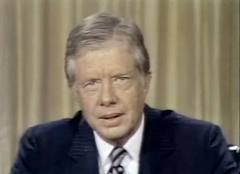
In 1979, President Jimmy Carter delivered his “Crisis of Confidence” speech, commonly referred to as his “Malaise Speech” although he never actually used that word. To a country reeling from stagflation and an oil crisis, it was an additional blow to our collective psyche. We felt poor, and other countries were getting ahead of us. Interestingly, the terminology he used could apply every bit as much today.

In a nation that was proud of hard work, strong families, close-knit communities, and our faith in God, too many of us now tend to worship self-indulgence and consumption. Human identity is no longer defined by what one does, but by what one owns. But we’ve discovered that owning things and consuming things does not satisfy our longing for meaning….

Whether we like it or not, owning things and consuming things are still the measurements by which we determine success today. Advertisers fight for every square inch of space to promote consumption. Five years ago, an article in the New York Times estimated that the average city dweller saw 5,000 ads daily. The number certainly hasn’t declined since.

The election has inundated us with claims that the middle class is worse off than it was twenty years ago. How is “worse off” defined as a measurement? For most of the world, “rich” could be defined as having indoor plumbing, 24 hour electricity and a motor bike. In America, “poor” can mean having only one television, one car, and an inability to eat at nice restaurants.

I caught the Sean Connery 1993 movie “Rising Sun” on one of my 400+ advertising-supported television stations last week. It was an amusing journey into our last period of general fear about our whole country being bought outright, although that time it was by Japan just before their financial crash. This time it is China. Our 19th century paranoia about the “Yellow Peril” lives on. The media tells us we are poor again, and that others are getting ahead of us.

How can we, as business owners, motivate employees who see no light at the end of the tunnel? Statistically, about one in five of them owe more on their houses than they can sell them for. In the worst hit states like California (one in three), Florida (almost half) and Nevada (two-thirds) many employees have simply stopped paying their mortgages. They have decided that their homes are a lost cause, and they would rather use wages for more immediate rewards.

A couple of years ago, when gasoline spiked to $4.00 a gallon, many employers offered assistance to employees who traveled distances to their jobs. Last month most of the country came near those prices again, but I didn’t hear a word from our clients about fuel assistance. On the whole, our employees are certainly no better off than they were, but we’ve made so many other cuts in our businesses that we now expect them just to tough it out. We assume that they understand why things are tight.

Money by itself is an indifferent motivator. No rational employee works harder in the mere quest for a bigger bank balance. It is what he or she can purchase from among the minute-to-minute inundation of advertising offerings that makes money desirable.

The primary reason people like their job is the social culture of the workplace. They spend more waking hours talking to coworkers than to their families (especially if you don’t let them watch TV on the job). They form friendships, and in a small company they know a lot about each other’s children and marriages.

As a businessman, you can’t buck the economy or two billion dollars worth of political advertising. You don’t have the ability to buy down the principle on your employees’ homes, or give them new cars. If you can afford to pay them a bit better than market rates, that’s great, but it probably isn’t going to change their impression of the world around them.

What you can do is make their workplace a haven from the drumbeat of doom that is surrounding them outside. As Mr. Carter said; owning things and consuming things does not satisfy our longing for meaning. When you can’t provide a job that fulfills all your employees’ material aspirations, it had better be addressing their need to do something worthwhile.

Posted in Leadership, Management, Thoughts and Opinions | Tagged , , , , , | Leave a comment

Leave a Reply

Your email address will not be published. Required fields are marked *