Year End Bonuses: Incentive or Entitlement?

It’s time for our annual discussion of the Holiday bonus.I pine for the days of my spiritual ancestor Ebenezer, who was offended at the expectation that he would pay Cratchit a whole day’s wages without receiving any work in return. One year I tried telling my staff to “make sure that you are in all the earlier the next day.” (It didn’t work.)

Today, the expectation of employees is that they will not only be paid for the day, but that there should be something more to show that they are really appreciated. That might be a monetary gift, or as is the custom in many small businesses, the “year-end bonus.”

Year end bonuses may theoretically be tied to profits, but since the year really hasn’t ended, they are often just subjective gifts. Owners give themselves some vague justification (the employees don’t need one) such as “We’ve had a good year” or, if cash flow is tight, “We’ve had a tough year.” They then consider seniority, or salary, or what the employee got last year, or the phase of the moon or some other specious excuse for measurement that has almost nothing to do with actual performance metrics, and they attach a dollar number to it.

From the employees’ perspective, the year-end bonus comes in two flavors. 1) More than I got last year, or 2) less than I got last year.

Knowing that, many bosses sit with last year’s table of bonuses, determining whether each should be increased or decreased, and by what percentage in comparison to others. They labor in the incredible belief that this single figure will serve as a performance review, reinforcement for good performers, warnings to those on the fence, recognition for (recent) past achievements, organizational bonding, retention incentive, cultural reinforcement, and a giant leap towards goodwill for all mankind.

Then the owner complains for two weeks that no one said “thank you.” Why should they? No one is sure if what they got was good or bad. They don’t know how they were measured, or whether they were at the top or bottom of the totem pole. No employee wants to look like an idiot by thanking the boss for what might have been a warning.

The holidays are a time for giving gifts. A gift is a token of your esteem for someone. It isn’t supposed to be determined by performance. It isn’t supposed to be calculated as just a little bit nicer or just a little bit smaller than the gift you gave to the next person. It isn’t supposed to be a major part of their family’s income.

Incentive or entitlement? The correct answer is “neither.” If you give out bonuses for performance, or really allocate a portion of profits for the employees, do it after the holidays. Keep the spirit of the season separate from incentives by giving gifts. They should be modest, and fairly even across the board. Make sure you call them gifts. When people know that they’ve received a present, they are more likely to say “thank you.”

Posted in Leadership, Management | Tagged , , , | Leave a comment

Leave a Reply

Your email address will not be published. Required fields are marked *

Holiday Terminations: Scrooge or Chicken?

This year, my first holiday termination conversation came on November 20th; a bit early in the season. Like traditionalists who hold off on Christmas decorations until after Thanksgiving Day, most business owners start avoiding termination announcements a few weeks before the holidays.With the Great Pumpkin replacing Macy’s Santa as the official harbinger of the holidays, and “Black Friday” sales starting on Thanksgiving morning, bosses are feeling the pressure of maintaining “Holiday Cheer” in the workplace for almost one-fifth of the working year.

This conversation was typical. “We need to cut costs, and have drawn up a list of folks we will be terminating. Because of the holidays, we will wait until the beginning of the year to make our announcements.”

Who benefits from waiting until after the holidays for a planned termination? Is it really the employee? When the credit card bills come in January for that last surge of overspending on gifts, will the employee say “Boy, I’m glad I didn’t know I was getting fired. I would never have had the nerve to go this far into debt?”

In reality, delaying terminations until just after the holidays is usually because the boss is a chicken. We worry that the social celebration that comes at this time of year will remind our employees what a rotten Scrooge we are if we’ve just fired someone. We imagine handing out holiday bonuses to people who say “thank you” but are really thinking about what you did to poor Cratchett, who occupied the now-empty cubicle next to them. We visualize holiday parties where friends of the ex-employee stand around the punchbowl talking about what Bob’s rotten boss did to him last week.

Terminating someone before the holidays helps them to budget rationally, and allows them to utilize the best networking time of year to get the word out about their availability. Despite the benefits, I won’t pretend that anyone will consider a pre-holiday termination an act of kindness. Job hunting in the weeks before the New Year is still a largely futile endeavor.

If you really want to be generous, terminate the employee with a substantial cash sum in hand. You might use any accrued vacation for part of it, but with prepaid holiday compensation and a bit more you can probably get them through the first of the year.

I know that it sounds ridiculous to pay extra to an employee you are firing. I can hear the arguments: “We don’t do that for anyone else.” (But you don’t fire other people during the annual doldrums in the job market.) “We can’t reward someone for doing a poor job.” (But it isn’t a reward, it is a gift.) “The other employees will feel that we aren’t being fair to them.” (True, but they aren’t going to praise you anyway.)

From a practical perspective, there is little or no difference between paying the employee now, and paying him to hang around for another month. To start, the employee was presumably an underperformer or redundant, that is why we are having this discussion. Throw in paid time off, a holiday bonus, and a typically slow time for most businesses and you have the worst ratio of the year between pay and productivity .

On the other hand, you have a chance to avoid being either a Scrooge or a chicken. Your announcement to the employees can go like this: “We have terminated Bob. Because this is an especially difficult time of year to be job hunting, we have arranged to pay him through the holidays while he seeks another position.”

It may not make you into Santa Clause, but you will feel better, and it will help shore up your punchbowl reputation.

Posted in Management | Tagged , , , , | 2 Comments

2 Responses to Holiday Terminations: Scrooge or Chicken?

  1. Sarah Burke says:

    Yesterday I was “involuntarily terminated” for the first time in my 55yr life…no one saw it coming. Anyway, today, still in quite a state of shock, I realize what high hurtles must be vaulted, in addition to the futility of engaging in a job search during the holiday season: filing (and hopefully qualifying) for UI; researching, deciding how to continue, and actually paying for, continued medical insurance which is mandatory in the state where I live; encouraging supervisors, colleagues, and professional associates to provide written recommendations while they are preparing for or are away for the holidays; and coping with depressed immediate family members; just to name a few. Had my employer waited until after the holiday season to terminate me, I could have been spared all these additional, time consuming, challenges and appropriately spent this most holy time of year in the joyful company of family and friends (many of whom are my co-workers). Employee termination during the holidays is an act of spiritual robbery that has a devastating impact which is farther reaching and longer lasting than termination at any other time of year 🙁

    • John F. Dini says:

      I’m sorry for your pain, Sarah. Unexpected termination at any time of year is a terrible experience. In cases where it is because of the performance of the business, I certainly promote sufficient severance compensation to carry the former employee through until interviewing starts again in January. If the termination is because an employee didn’t respond to progressive discipline or a performance improvement plan, then I don’t see an obligation to carry someone in the “spirit of the season.” You say that you didn’t see it coming, so I assume either it was the first issue (overall business performance) or your former employer didn’t follow fair and equitable HR practices. From a job search perspective, use those contacts and stay joyful. Even your best friends don’t want to be dragged down at holiday events. Regardless of how you really feel, use this social time to act excited about making a change, and ask those in your circle outright for connections that might lead to new opportunities. My heartfelt good wishes in your search.

Leave a Reply

Your email address will not be published. Required fields are marked *

Success: Is Good Enough, Good Enough?

On Friday’s On Point program on NPR, Devlin Barrett and Tom Ricks discussed the burgeoning “Generals’ Affair” scandal. This weekend, the Wall Street Journal has a commentary by Senate Minority Leader Mitch McConnell, which reinforces several analyses in that paper last week. The two have something in common, and an interesting parallel to small business.

Part of the radio conversation focused on the opinions of Petraeus as a great General, with specific comparisons to George S. Patton. His handling of the “surge” in Iraq, when the US was in real danger of another ignominious Vietnam-type withdrawal is, according to this viewpoint, tactically equivalent to Patton’s strikes across Europe in WWII.

The problem with that thinking, as the commentators pointed out, is that Petraeus didn’t win. We still withdrew from Iraq, leaving a country in turmoil with a strong insurgency, and without curbing the growing influence of Iran. It is true that Petraeus did a marvelous tactical job, but he didn’t accomplish the big objective.

Similarly, the WSJ stories about Mitch McConnell described why he can’t cooperate in any tax increases, because he has to stand for reelection in two years. The premise appears to be that he can fail to fix the country’s problems, but will still be considered successful if he personally retains his position.

As small business owners, we don’t have the same flexibility in judging our results. Small businesses either succeed or they fail. I’ve met many former owners who tell me that their business had a great product, but unfortunately enough people didn’t buy it. Others say that they delivered a terrific service, but they couldn’t price it well enough to make a profit. Not to be harsh, but we call those failures.

We live in a black and white world. Your definition of success as a business owner may be as modest as financial security for your family, or it may be as ambitious as growing a large corporation that employs thousands of people. It is probably something in between. But whatever the objective, I never hear business owners say that they judge success as being just “good enough.”

No one is asked to deliver a presentation titled “I am a great entrepreneur, because I avoided failure” Other owners would laugh the speaker out of the room. How would you feel about a doing business with a company whose mission statement said “We don’t worry about delivering what we are paid for, as long as we get paid?”

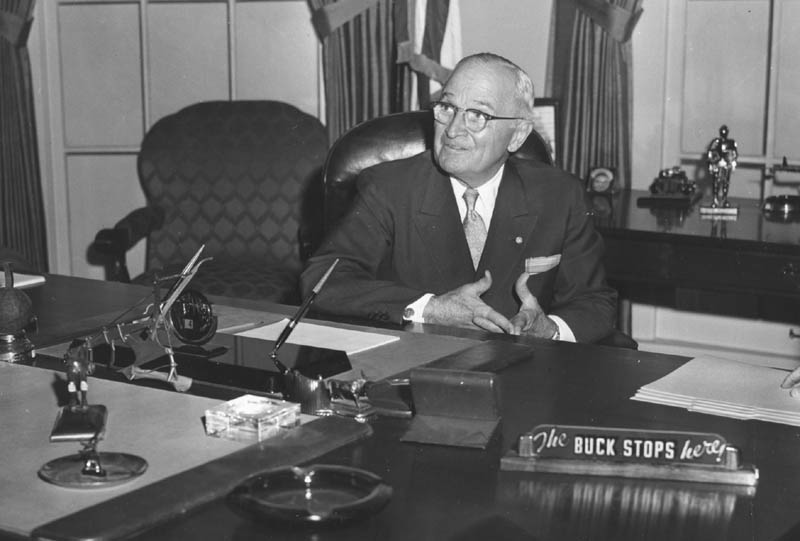
Harry Truman was the last President to have owned a small business. It failed. His famous desk plaque, “The Buck Stops Here,” was a small business owner’s view of the world. He didn’t blame his generals, or his cabinet, or market conditions. He knew that success was success, not merely avoidance of failure, or of the blame for failure.

As business owners, our concept of success or failure isn’t fungible, it’s inherent in everything we do, every single day. Harry Truman had worked without a net. He understood a world where failure wasn’t softened by a fat pension, transfer to another department, or a speaking tour.

Posted in Entrepreneurship, Leadership | Tagged , , | Leave a comment

Leave a Reply

Your email address will not be published. Required fields are marked *

An Independent Look at the Election

The biggest disappointment of last Tuesday’s election, as I opined in an article by the San Antonio Express News, is that on Wednesday the national political landscape still looked a lot like it did on Monday.

I tried to write this week’s column about business lessons from election marketing, but it was weak and didn’t say anything that hasn’t been said a million times already. I need to take this space to discuss what happened, and what has to happen next.

I feel that the American people spoke clearly. The fact that it seems to be a mixed message is due to an inability by the decisive swing voter, the 40% who identify themselves as independent, to enunciate anything that can be heard above the din of the warring factions.

We reelected a President who seeks new taxes and an expansionist role for government, while simultaneously giving him a House of Representatives (which originates all spending decisions), that is opposed to both. Even more revealing, however, were the results of the elections for statewide offices; those for Senator and Governor.

The Democrats took every Senate election that was even remotely in reach. At the same time, the Republicans seated an all-time record number of Governors. Indiana voted for Romney, and sent a Democrat to the Senate. Wisconsin also chose a Democrat for Senate and committed their electors to President Obama, while Republicans simultaneously swept both houses of that state’s legislature. What’s going on?

At the almost certain risk of scathing remarks from the true believers on either side, I think both parties failed to convince the plurality of voters in the middle that they could follow sensible paths, that they would be willing to move to the middle to get things accomplished.

The problem is plain. For almost a century, the United States Congress had a balance, regardless of which party was in power. If the Democrats wanted to expand social programs, they needed the assistance of moderate Republicans from New England, the Middle Atlantic and the Great Lakes (blue states). Those Republicans would say “I like the idea, but we have to be careful about the spending. Scale it back a bit and I can support you.”

Similarly, when Republicans wanted stronger defense or looser market regulations, they had to approach conservative southern Democrats. Those “red state” Dems would say “OK, but not enough to let Wall Street or the generals run amok. Let’s keep some oversight in place here.” The laws that came out weren’t so much compromises as they were the agenda of the party in power, tempered by the others they needed to get it through.

Over the last 15 years, both parties have purged those “moderate” members from their ranks. The socially liberal Republican has gone to the boneyard to lie down next to the fiscally conservative Democrat. To make up for those lost votes, the parties have wielded their fundraising muscle to force 100% adherence to the party line, making razor-thin majorities into a bloc on every issue.

I’ve collected multiple stories about threats and ostracization on both sides against those representatives who dare to vote the party line only 96% or 98% of the time. Younger representatives say frankly that they don’t know members of the other party well, and that even conversation with them is discouraged.

Thomas Jefferson was adamantly against political parties. He said that if parties became powerful, then inevitably elected officials would owe allegiance to their party over the country. The parties today, with their ability to direct the billions of dollars needed for television advertising, are more powerful than ever before. Thomas Jefferson’s fear has come to pass.

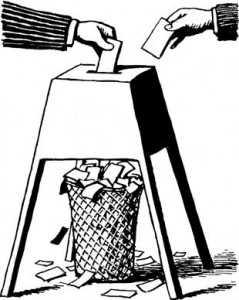
The 40% of Americans who don’t buy into either party’s platform entirely are desperately trying to find a solution using the only tool they have, a split ticket at the ballot box. We can only hope that some courageous statesmen and stateswomen respond.

Posted in Uncategorized | Tagged , , , | 2 Comments

2 Responses to An Independent Look at the Election

  1. Jim Marshall says:

    In Wisconsin and many other states the GOP got re-elected partially because of the redistricting (read “gerrymandering”) they did. The Dems would have done the same to their benefit if they had been in power.
    I think another factor affecting both parties in the state (local) elections is the familiarity the public has with their incumbants. In some cases its “even though he/she votes the party line” they are “nice guys”. In others it’s “the devil we know is probably better than the devil we haven’t gotten to know”.
    I think the concusion I have reached from the above and from what you have written and the obvious power of the corporations and their lobbyists (as well as labor and its lobbyists) is that we live in an ungovernable country. I hope your conclusion (election of courageous statesmen and women, comes to pass….but with the cost of campaigns and the need to depend on large donors remains and grows….I don’t know how that will happen. Or whether a public that thinks only in black and whites would accept them
    Cleo and I just returned from a European trip including Greece. People we talked with referred to the disenchanted students and others being satisfied for the present with expressing themselves through graffiti and mostly peacful demonstrations against their incompetent and corrupt government officals. They fear for when that will not be enough.
    Here at home I fear for the same, as the gap between the haves and have nots grows so fast and far…and the feeling of helplessness and frustration grows among just about everyone.
    So, Mrs. Lincoln, other than the shotting….how was the play?

  2. Bill Seelig says:

    Unfortunately, “neither” party dared take on the banks, the large corporate givers and the unions; those that sponsor most electiced officials for their own gain. While those outside this inbred system are beginning to be heard, it will take a monumental effort to successfully challenge the current way of doing business and return to a heathly, more balanced approach to our economy and the people they serve.

Leave a Reply

Your email address will not be published. Required fields are marked *

Sales: Do You Have Customers or Clients?

Whether you have customers or clients is more than a matter of semantics. Some businesses use the term “clients” in an attempt to class up their image. Attorneys usually have clients. Kentucky Fried Chicken doesn’t, regardless of what they might say. Nordstrom? …We’ll see.

I am loath to fall back on the hackneyed “Webster Sez” device in writing (try reading some high school essays. It seems about one in three start that way), but here is the dictionary approach, mercifully shortened.

A Customer is one who purchases goods and services

A Client is one who uses professional services.

I’m sorry, but those definitions are both weak and useless. The type of services (or goods for that matter) have little to do with whether you seek customers or clients for your business.

Customers are buyers who establish a relationship for the purposes of conducting a transaction.

Clients are buyers who conduct a transaction based on a relationship.

So a storefront attorney who offers cheap wills, incorporations and other standard form-based serviced has customers, despite the fact that he is a professional. An attorney who creates detailed estate plans has clients.

Costco has customers. They go there to buy stuff at good prices. Nordstrom has clients. Going to Nordstrom is their buying decision. What they buy depends on the need of the moment, but whatever it is they are buying it at Nordstrom.

eBay has customers. Amazon has clients. Ah Ha! You disagree? I argue that Amazon has proven that they can attract buyers who are looking for power tools and skiwear, pet supplies and perfume. I have clients that sell those things through their own web presence as well as through Amazon. The numbers Amazon can produce for any retailer are breathtaking.

They don’t promote power tools, they promote how Amazon serves its clients. Amazon has extended their client relationship to other vendors as a substantial profit center of its own. In fact, how much of Amazon’s profits are still from selling books? They sell clients.

How about your company? I hear many owners say “Our business is based on relationships. Our clients work with us because we have long-term relationships with them. Of course, that S.O.B. down the street who is cutting prices is taking a lot of them away.”

News flash- those are customers, and they aren’t buying on relationship. They may be buying because they see value in what you sell, and there is nothing wrong with that, but that doesn’t make them clients.

A very few high-class call girls have a strictly limited client list. The rest have customers.

Perhaps the world’s greatest curmudgeon, George Bernard Shaw, once argued at a society party that everyone had their price. A well-dressed woman demurred, to which Shaw reposted “Madam, would you consider sleeping with me for a thousand guineas?” She allowed that for such a large sum she would have to consider it. “Well then, how about sleeping with me for a shilling?”

Certainly not!” she exclaimed. “What do you think I am?

Shaw’s immortal comment “We’ve established that, my dear. Now we are just haggling.” is a classic. Like most classics, it endures because it is so true.

Clients or customers? The answer is what you want it to be, but regardless of price, customers aren’t clients just because you say they are.

Posted in Marketing and Sales | Tagged , , , , , , | 2 Comments

2 Responses to Sales: Do You Have Customers or Clients?

  1. Clint Moar says:

    Ha! Love the Shaw comment…
    Thanks John.
    This is one that I’ve always wondered about as well…I never liked the word “client”, felt like those using it were trying to sound important…I’ll never be a lawyer so they’ll always be customers (buying something)…
    Clint.

  2. John, thanks for your article. I agree with your distinction between the two. Perhaps, though, it does not go far enough.

    It seems to me that “customers” purchase goods and services which have been commoditized; that is, items for which little value derives from an ongoing relationship with the supplier or intermediary providing the commoditized goods or services.

    “Clients,” on the other hand, purchase some goods, and more often services from people or businesses whose approach, advice and supplementary services they trust and value. Therefore, the elements of “trust” and “value” figure into the distinction between the two.

    Finally, those of us who have clients need to recall that the meaning of “trust” and “value” must be based on the buyer’s personal perception … not our own. Too often, we focus on what we believe is valuable rather than focusing on “value” as defined by the client/buyer.

Leave a Reply

Your email address will not be published. Required fields are marked *