Employee Incentives that Work

After four blogs on the long term motivations for running a business, perhaps it is time to return to some more practical advice. One of the most persistent issues for a business owner is trying to motivate employees with incentives.

You install a perfectly good incentive plan. It gives the employee opportunity to make more money, or to enjoy a perquisite outside his or her normal compensation. You roll it out with appropriate fanfare. The feedback is positive. The workers are excited. Then…nothing.

What happened? Was it the plan, the goals or the employees themselves?

Frequently the answer is all three. Here’s a quick primer on why each element in the process can fail, and how to work through it.

The plan may not have been easily understandable. If it requires the employees to wait until management tabulates the numbers and tells them if they’ve won or not, it is worthless. It’s like bowling under a curtain. Effort, noise, but no idea of where you are in the standings.

The goal must be achievable. I often recommend a goal in the beginning that is the same or only a little more than what they do already. You need to get the employees into the habit of winning, but winning with effort.

Employers get lazy with incentive plans. They try to tailor a one-size-fits-all. If the employees succeed in earning $100 each in the first bonus period, then logically they’ll want to get $200 each in the second, right? Actually, no. They will usually try to earn the $100 again, and again. Increasing performance requires a willingness to change plans often. It also means changing them even when they are working, before they run out of steam.

Aaaarrgh! I can hear the moans in my reader community. “It’s hard enough to develop one plan. How am I supposed to keep coming up with new things all the time!”

Actually, it’s easy and effective. Use the old BCG (Boston Consulting Group) two-by-two matrix. That’s where you have four sectors, and each represents a combination of two factors. My thanks to Gerald Stowers, the President of Execupay for showing me this one.

Draw a square on a piece of paper. The divide it into quarters by bisecting it top to bottom and left to right. Then label the Y axis “People” and the X axis “Type.”

We are going to vary the incentives by two factors: whether they are for a group or an individual (People), and whether they are monetary or non-monetary(Type). You should wind up with something that looks roughly like this:
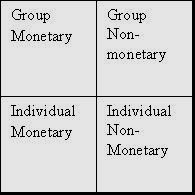
A short guide to the types:
  • Group-Monetary: “If the whole team averages 85% customer satisfaction, there will be a $100 bonus for each team member.”
  • Group Non-monetary: “If everyone on the team opens at least one new account this month, we’ll all have a pizza party.”
  • Individual Monetary: “The highest producer will receive a $500 bonus.”
  • Individual Non-monetary: All kinds of things.Trips and tickets are popular, but this category includes a lot of recognition. Trophies, pins, plaques and such.

Most business owners are Hunters, as the introduction to this blog suggests. They lead teams, but expect to reap individual rewards for their efforts. Not all of your employees are the same as you.
Some are hunters, of course, but even so they may not be all that motivated by money. Recognition, or a change in the routine (an extra 3 days of paid vacation) may excite them a lot more.
Your farmers are more likely to be excited by helping everyone. “Let’s all do this together” is their battle cry. Of course, the hunters involved in these type of programs will be the ones to pressure the low performers. Team incentives work because the motivated individuals push the team for their own benefit, while the team players do it for everyone’s.
Change incentives regularly. If something works well, don’t just ride it until it becomes ineffective. Terminate it according to schedule. If it was popular, it will just be that much more exciting the next time you use it (with a higher goal, of course).
Keeping incentives fresh, simple to track, and varied enough to appeal to different personalities will make them far more effective. 
Posted in Management | Tagged , , , , , | Leave a comment

Leave a Reply

Your email address will not be published. Required fields are marked *

Lifestyle or Legacy – Part 4

Last week a client told me “You are wrong. I have a lifestyle business that is ALSO a legacy business.” Sorry, but that doesn’t fly.

He has built a good company, and continues to improve it. Be he is not driving to make it into something that carries on beyond him. His objective is to (eventually) make it large enough to be acquired, and for enough money to live in luxury for the rest of his life.

That is a lifestyle business. It’s only purpose is to fund the financial aspirations of the owner. There is no larger purpose, no overarching vision of something beyond his quality of life. I’ll grant that his personal ambition extends beyond his current, very comfortable existence. But it only extends to a more comfortable existence. That is a matter of degree, not direction.

When I started to think about this series, the term “lifestyle” was easy. The second term was originally “entrepreneurship.” That didn’t communicate the concept well enough. Thinking through the topic, it reduced the definition of “lifestyle” to more of just making a good living, and of “entrepreneurship” to building something larger than merely a decent living.

What I am talking about encompasses ANY lifestyle you choose. Whether it is a nice house in the ‘burbs, or sailing around the world in a yacht, that is still lifestyle. We all have different targets.

Legacy is when it moves beyond you, when the company becomes a vehicle for accomplishing something larger than your personal quality of life. By that definition there are probably legacy businesses that don’t provide a luxurious lifestyle, but they satisfy the owner’s desired level of creature comforts and support that bigger vision. Perhaps something that allows an owner to go on missions to Africa for half of each year might qualify. For the most part, however, owners have to reach a pretty comfortable lifestyle before legacy comes into the picture.

Most legacy businesses were lifestyle businesses first. The owners scratched and pushed (or were incredibly lucky) to build a level of security and sustainability. Once they got here, however, they looked around and said “This isn’t enough. Mere wealth doesn’t fill the need I have inside of me.”

Another owner said to me ” I want a legacy business. I want to go visit my outlying offices and not fix problems. I’d fly in, give awards to the top performers, and take a major client out for golf.”

That is also a lifestyle business. The legacy owner wouldn’t be coming in to fix problems either. He or she might be looking for an acquisition in that market, or communicating new goals. He might be upgrading personnel; not because they were failing, but because he was constantly looking to do better. The numbers are still important, but they aren’t going towards improving his lifestyle, they are being used to build the legacy.

Before you start worrying about the lifestyle vs. legacy decision, let me make something plain. Some 80% of small businesses fail in their first few years. Of those that survive, probably 90% never achieve the lifestyle level of success. There are very, very few owners who reach a point where they can work as little as they want and make as much as they want.

Some do, and a few of those think “OK. Is that it?” Some of those can’t envision anything else. Some start building a legacy.

To quote Nancy Barcus: “The closer one gets to the top, the more one finds that there is no “top.”

Posted in Exit Options, Exit Planning, Exit Strategies, Leadership, Life After | Tagged , , , | Leave a comment

Leave a Reply

Your email address will not be published. Required fields are marked *

Lifestyle or Legacy – Part 3

Let’s turn to the Legacy Builders.They are the business owners who have achieved Lifestyle status (as defined in the last posting) but continue to work hard to build their businesses. Their objective is a company that does far more than merely provide a comfortable lifestyle and assure retirement.

A little bit of elimination to start, as we did with the Lifestyle owners. Just as we said a Lifestyle Business was neither a pumped-up hobby nor merely an adjunct to an alternative lifestyle, the Legacy owner isn’t a couple of things that people might normally assume.

Let’s set a baseline. The typical Legacy Builder runs a business that is very capable of continuing its day to day activities independently and indefinitely. Operations, management and sales are handled by competent employees. In fact, each is probably better than the owner at what he or she does. They are in the top 1% of American incomes. It varies widely, but we’ll call it a minimum of $500,000 a year. The Legacy Builder nonetheless chooses to work a full (45-50 hour) week to continue developing and improving the business, and not incidentally adding to its profit.

The Legacy builder is clearly not obsessive-compulsive, a workaholic, or in any other way driven unwillingly to work beyond common sense. It’s easy for observers (and sometimes family) to accuse the Legacy Builder of being enslaved to the job, unable to tear away for a personal life. That isn’t true at all. The Legacy Builders I am describing spend time with family and other pursuits. They coach Little League, attend recitals, and are active in the community. They take nice vacations (usually with family), and live in nice homes (often several of them), but are seldom ostentatious.

It is true that they are frequently missing in the devotion of time to community activities, preferring to fund the work of others. In fairness, I’ve spent a lot of time working in community organizations. There is a lot of wasted time. If I had the money to pay for someone else to do it, I probably would. Legacy Builders don’t like to have their time wasted.

They are also not greedy. Their continued push for improvement is not for the personal gain. They seek greater success for other reasons. As Bill Gates once said, “Money is just a way to keep score.”

I call them the Legacy Builders because they have an eye for a target that is beyond merely running a successful business. They have a bigger picture; a larger objective in mind. Developing an organization that lives beyond their own careers is at the core of their strategy, but it isn’t just monument-building that drives them. It is what that organization can accomplish.

Some are motivated by the benefit to the community that their talent can deliver. More jobs, more people who can provide security for their families. For others it is even a greater community responsibility, the money to form a foundation, or to fund worthwhile causes. For others their family is the motivation. They seek to change the lifestyle of their children, and their children’s children, permanently (or at least for the next few generations).

Many of the Legacy Builders are simply entrepreneurs without a limit on their creative drive. Most business owners have a difficult time looking backwards. Yesterday’s achievements are ancient history. They see no point to basking in past accomplishments when there is so much more that could be done.

Some Legacy Builders attempt things for the thrill of accomplishment. Once attained, the successes immediately become the basis for the next level, the next mountain to climb.

Admittedly, a substantial number of Legacy Builders have a head start when compared to bootstrap entrepreneurs. They achieved a substantial level of success in an existing organization, and used that as a spring board for their own purposes. They may come from a family where there was Legacy-type success in the past. They may have just been lucky. But none of those things explain their push for greater achievement in business when they are long past the point at which most owners would be satisfied; and there are plenty of bootstrap start-ups in the Legacy class to disabuse the notion that the game is fixed at the start.

Most Lifestyle owners say that they really want to reach Legacy levels, but few actually do. In my next post, the last in this series, we’ll look at what it takes to make the leap from Lifestyle to Legacy.

Posted in Exit Options, Exit Planning, Leadership, Life After | Tagged , , , , | 1 Comment

One Response to Lifestyle or Legacy – Part 3

  1. Trina Hoefling says:

    Great series you're building here, John! Spot on. Thanks, Trina

Leave a Reply

Your email address will not be published. Required fields are marked *

Lifestyle vs. Legacy – Part 2

Let’s define a lifestyle business. For our purposes, I’ll start with what it isn’t.

It’s not the small retail store being run by someone who doesn’t need the money. A few years ago I was on a judging panel for a business award. One of the finalists told her story of how she struggled and labored to build her company. I was getting pretty impressed, until she mentioned that she hadn’t turned a profit until her 13th year in business. Fortunately, she said, her husband was a prominent surgeon and could afford to absorb her losses indefinitely.

That’s not a business, it’s a hobby. And it’s one that has an unfair advantage against the real businesses that have to compete against it.

I’m also not talking about the fantasy businesses that regularly grace the pages of Inc. Magazine and Entrepreneur. You know, those stories that read like a cross between People magazine and the Whole Earth Catalog. Where people live in a mountain top retreat, go kayaking with their employees on Tuesdays and Fridays, and sell imported herbal teas on the Internet. I envy them, but the number of such businesses are limited. Most of us are in far more plebeian environments, where the business requires hard work and constant attention.

My definition of a lifestyle business is one that allows you to live the life you want. The business isn’t integral to your lifestyle, as with the mountain-top tea seller’s. It is any business that generates the income you need to achieve your personal vision, and runs well enough to give you sufficient time to spend that income the way you choose. It can be any business, as long as it is one that can be separated from your personal life.

I’ve observed that most small business founders are seeking a lifestyle business. Their dreams include some base line achievements; financial security for their families, the ability to retire in comfort, and a few weeks of vacation without calling in to run the company by remote. I think those are the trip wires for defining the beginning of a lifestyle business.

Those basics are really just the criteria for a well run business. It has to go a bit further than that for a business to truly achieve “lifestyle” status. It mostly revolves around coming and going as you please. Depending on your interests, it may be working a four day week, or leaving at 3:00, or taking the children to school each day before coming in. Of course, in order to qualify, you can’t be slammed when you return as the price of your “free” time.

It also has to fund not only your immediate and future financial needs, but also generate sufficient excess to let you indulge in your chosen activities without sacrificing elsewhere. Private schools are a quality choice, not an economic decision. Recreation destinations are determined by the activity desired, without worrying about time, distance, equipment or cost. Physical fitness regimens are scheduled each day or week, and the business simply has to fit around them.

If you are not in the office, your phone doesn’t ring with problems; they are handled in the normal course of activity. If you say that you are going out, no one is worried about when you’ll be back. If the business has an off month it doesn’t affect your paycheck. When you want information of how the business is running, it is available instantly, preferably on your smart phone.

For the vast majority of small business owners, this is a description of perfection. I work with a number of business owners who have achieved this, or are close to it for extended periods of time. But I also work with many who are well past this point, yet continue pushing the envelope to make the business grow. These are the Legacy Builders, and we’ll discuss them next time.

Posted in Exit Options, Exit Planning, Leadership, Life After | Tagged , , | Leave a comment

Leave a Reply

Your email address will not be published. Required fields are marked *

Lifestyle vs. Legacy – Part 1

There are three types of business owners. The first, which encompasses the vast majority of small businesses, is the one who simply wants to make a living from running his or her business. They dream of the day that they can take vacations without worrying about the impact on their companies. Sometimes the biggest goal is to go home at five, or just to sleep through the night without worrying about the next day (thus the name of this blog).

But if you are tenacious, if you execute on your plans and are able to groom good employees, eventually you will join the owners who can take a good living for granted. Then you have to determine whether you want a lifestyle or a legacy.

I work with both lifestyle and legacy owners. Either would be considered successful, in the sense that they have a comfortable lifestyle, expect to retire at a time of their choosing, and, barring mishaps, should be able to enjoy their retirement doing what they wish. They run their businesses very differently, however.

It doesn’t matter what type of business you own. I coach legacy builders in manufacturing, distribution and professional services. I also coach lifestyle owners in all industries. It has a lot to do with personal vision, but the legacy builders aren’t driven by merely a “bigger” vision. They see their companies and their lives as having a different objective.

The differences are pronounced and complex enough to warrant several columns on the subject, of which this is just the first.

First, let’s define wealth, since the perception of wealth is a substantial part (although not by any means all) of the difference. A few years ago my family was skiing at Deer Valley, Utah. For those of you who haven’t been there, Deer Valley is a beautiful resort. It’s one of those that was developed as a ski resort, not as a ski mountain that eventually generated other development nearby. That means, like a golf resort, prime home sites were incorporated near the ski runs for those who could pay a premium for the location.

As you go up the main lift, the homes along the lift line are lush, and some are breathtaking. Three and four stories, 15,000 feet or more, some with indoor pools on separate glassed-in floors that are integrated into the main structure. I can’t even estimate the prices, but they are astronomical.

My younger son, who was 14 or so at the time, gaped at some of the houses as we went up. He turned to me in the chair and said, “Dad, what is rich? Friends come to our house and say ‘Boy, you are rich!” but you say we aren’t. The people who own these houses (he first thought they were small hotels) are clearly rich. What is rich?”

I took a few hours to formulate a response. That night over dinner I replied. “Son, in your public high school you have many classmates whose parents work hard at a job just to provide the necessities. When they come to our house ( an older 5 bedroom on a suburban acre) it is much more than they have, so they think we are rich.”

“There are three kinds of rich. The first is well-to-do. That’s what we are. We go out to dinner in a restaurant not just for special occasions, but whenever we don’t feel like cooking. We take vacations to see other cities, or to do fun things like ski or swim. If we need a new car, or something big fixed around the house, we just do it and don’t have to worry too much about being able to pay for it. But your mother and I both have to work very hard in the business to afford our lifestyle.”

The second kind of rich we will call ‘wealthy.’ That’s when you can live like we do, but you don’t have to go to work every day to make it possible.”

“The third kind of rich we’ll call “escape velocity.” (I think that term was coined by Bill Gates, who is probably the epitome of it.) That’s when you can pretty much do anything you want every day, and when you go to sleep you still have more money than when you woke up.”

Lifestyle business owners have reached the second kind of rich, or are approaching it. Legacy builders are seeking much more, and it isn’t merely about money. (Escape velocity depends on factors that few business owners can control.)

Next, we will look at the lifestyle of a lifestyle owner, and what your business needs to make that possible.

Posted in Entrepreneurship, Exit Options, Exit Planning, Leadership, Life After | Tagged , , , | Leave a comment

Leave a Reply

Your email address will not be published. Required fields are marked *