
Can Startup America revive US small business?

A couple of weeks ago in my opinion blog “Awake at 3 o’clock” I pointed out that politicians pronouncing small business owners as the saviors of the economy is a misplaced strategy. (“SMB isn’t the cure for the economy“) Most SMB owners are ageing Boomers, disinclined to take big risks as they seek greater retirement security.

Now the government is rolling out a new program “Startup America” to foster the development of innovative entrepreneurs. The program will support early-stage companies by improving access to capital, mentorship and education while reducing red-tape and regulatory barriers.

I’m proud to note that as the owner of a franchise of The Alternative Board, I will be included in the participating mentorship partnerships.

I’m also inclined to favor an organization with a Board of real entrepreneurs. Folks like Michael Dell and Magic Johnson presumably are still close enough to their startups to remember what it was like. The CEOs of Under Armour, FedEx and LinkedIn all built companies from scratch. No politicians – now there’s a worthy idea.

As good an idea as this is, I have a not-unexpected skepticism of the role of government in the business markets. I work with a number of 8-A, HUB, WBE and other businesses that enjoy some special status in government contracting.

I’m not going to riff on the “Caucasian Males Get Shortchanged” theme. The programs that favor folks who were traditionally shut out of a lot of opportunity have a purpose. They really don’t (contrary to the belief of a lot of those left on the outside) steer a lot of work to those classifications. It is a tool that lets you hunt work, but it doesn’t just dump money in your lap.

What it does is make a lot of large corporations look at subcontractors and vendors they would otherwise ignore. I’m not sure if a giant multinational surrounded by small businesses, like pilot fish around a shark, is a good thing or not. It is, however, an opportunity. What it clearly does as well is to wrap a whole lot of regulation around the process of choosing a vendor.

So I wonder if “reduced” regulation can really mean “May the best ideas win” in a government controlled environment. How will ideas be judged? Will there be room for the next Under Armour, which is “merely” another, albeit innovative clothing company? Or will we quickly see a predisposition towards “cool” industries – clean energy, technology, and the Internet?

An interesting feature of the Board is the number of members whose companies are largely or wholly based in the USA. I’m entirely in favor of building jobs at home, but it is a global marketplace. Might there be a bias towards companies that locate in the “right” area or hire from the “right” population? 

How does a government-supported organization not have  politically correct agenda?

Let’s hypothesize an example. One company is working on an idea for storage cells, located in Gary, Indiana, with a business plan that calls for fabrication and distribution by training high school dropouts in depressed inner-city neighborhoods. Another has a similar product concept, but plans on developing it with an international team of engineers located both here and in Asia, and manufacturing where it costs the least.

The latter company may have the better idea, but can Startup America handle a headline that says “Taxpayer Supported Businesses Send Their Jobs to India?”

Could the current (or any) administration say “We think entrepreneurial creation is a chaotic and wide-open world. We accept the fact that not all will succeed, not all will get a fair shake in the marketplace, and not all will do things in a manner that pleases everyone. In the long run, we think making something happen is more important than trying to only make the right things happen.”

I’d love to see it, but I can’t quite envision it. None the less, I plan on finding out how I can support Startup America. Standing on the sidelines being cynical isn’t accomplishing anything. I do believe that making something happen is better than worrying about whether it’s exactly the right thing.

 

Posted in Entrepreneurship, Thoughts and Opinions | Tagged , | 1 Comment

One Response to Can Startup America revive US small business?

  1. Tom Morton says:

    Thanks John — a very interesting and thoughtful piece. On our side of the Pond we also have a continuing series of Government initiatives to stimulate small business, and they also suffer from the same constraints you identify.

    Your last sentence, however, is key (and to many other fields as well)

Leave a Reply

Your email address will not be published. Required fields are marked *

The Catch 22 of IT management

Are you big enough for an “in-house” IT professional? With the rising cost of service by outside firms, many smaller businesses are trying to hire someone to take care of their technology needs.

Of course, many small businesses are still trying to ignore their technology needs. I am surprised at how many times I get a belated answer from someone that starts “Sorry, but our email has been down for a week.” Those companies are simply playing roulette with their business. I’m talking about the ones who are really trying to maintain secure, up to date systems.

Like any skill you bring into your business, you’re going to start with one person. You can’t make the leap from nobody to a whole department. So how do you approach hiring a single technology professional?

As with any other position, you could aim high or go cheap. Let’s say for a moment that any compensation within reason is acceptable. Do you pay, say, $75,000 for someone with certifications and extensive experience, or more like $40,000 for someone who is self taught?

Part of your thinking, or course, revolves around how much you are paying for outside support now. That support won’t go away entirely, however. No single technician knows everything about everything, no matter what he claims, but service-by-the-hour gets more and more expensive (See my “Subscription IT column” of 6/27). 

If you under-hire, there is the very real danger of your in-house tech getting into something over his head, or making a mistake. Then getting the outside firm to come in and do  break-fix is going to be really expensive.

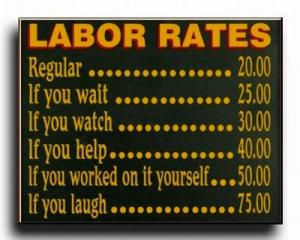
Do you remember the old joke about auto repair rates? I’ve seen this sign or one like it on the wall of a hundred shops (but then, I sold to auto shops for 10 years.) The times (and prices) have changed, but the sentiment remains the same. If you call a professional to undo the work of an amateur, you are going to pay a premium for that service.

So then the logical alternative would be to hire a top gun, right? That is where we run into the Catch 22 of today’s title. Computer technology is a rapidly evolving field. Staying current is a critical core competency for any professional. In a service company, the technicians are regularly installing the latest equipment. They see how many different configurations interface. They get a heads up on new problems almost daily.

But individual private companies don’t change their equipment frequently. The technician can expect to work on the same hardware for years. That is a problem that causes may of the most skilled to avoid one-man shops. The ones that accept such a position really start falling behind in their technical skills the day after they start.

Now you have an expensive employee with deteriorating skills. It should come as no surprise that his paycheck doesn’t decline with his market value. We see many companies who keep upgrading outmoded technology because “It’s what our IT guy knows.”

If you want  to have the quick service and attention of an on-site IT employee, by all means hire someone to handle the help desk and general hardware/software support. Unless you plan on building a department, however, don’t try to run your business with an all-in-one-man (or woman) solution.


Posted in Thoughts and Opinions | 1 Comment

One Response to The Catch 22 of IT management

  1. Great post! I’ve been toying with the idea of hiring an in-house IT person for quite some time now. Useful insight on having a one man shop vs. building a department. I agree that building an IT department is the way to go so your business doesn’t end up falling behind the IT curve.

    The Small Business Blog

Leave a Reply

Your email address will not be published. Required fields are marked *

“Intuitive” Doesn’t Work for Organization

Apple Computer has become the most valuable company on the planet by making products that are “intuitive.” Most Apple fans brag that you don’t even need a user’s manual to get started on their products.

Intuitive is a relative term. With Ipods and Macs, it means that you can figure out commands without guidance. It presumes, however, that you know what the commands are before you start. Turn on. Look through the files. Start. Stop. Reverse. Copy. Save.

Organization isn’t intuitive. How a group of people perform a collective task, or work towards a common goal, has as many intuive approaches as there are participants.

Take filing for example. How many human-hours of productivity are spent looking for a document on the company server? Have you ever had a conversation that goes something like this?

“Where is the ABC proposal? I looked in the marketing files, the customer files, the correspondence files and the presentation files. I can’t find it anywhere.”

“Oh, those are filed in sales commissions under the last name of the salesman handling the account. We don’t open a customer file until the proposal is accepted.”

The next hurdle is often the naming convention for each file. Looking under the saleman’s name you find “Machine Tool Proposal” and “Proposal to Johnson.” Neither is identified by company.

Or you find the supposedly well-organized and documented “Proposal to Johnson,” filed together with “Proposal to Johnson ver 2,” Proposal to Johnson ver 3,” and “Proposal to Johnson April 17.” Which is the one that was sent to the customer? Is April 17 the first one or the last? Or, maybe you need to look further to see if there is one called “Johnson Proposal-final,” or perhaps “ABC Proposal for Johnson?”

The rise of the individual

The power of personal computers has caused two trends in the workplace. First, it encourages employees to “Have it Your Way” in a resurrection of the old BK slogan. Their computer is a part of their personal space. They have their own individual Outlook themes, email rules, and Internet bookmarks. They customize their desktops and screen savers. The personal computer is, after all, personal.

The old centralized computer systems had no provision for individualization. They were regimented. They were organized according to a rigid heirarchy. Employees disclaimed “I am not a computer!”

Now the employee and his or her computer are linked in a weird symbiosis. Even approaches to common tasks are individual. Have you ever tried to rework someone else’s spreadsheet formulae, or reformat a graphic document created by someone else? You almost have to transcend logic, and understand what went on inside the mind of the creator. Often it is easier just to start from scratch.

I know that I’m being a bit “old school.” My staff seldom looks through the files for a document. The improvements in file indexing software make it much easier to just search your drives like you would the Internet. A few key words can bring up what you seek.

The Room of Requirements

That leads to the second problem. The cost of storage capacity has shrunk to a miniscule relative number. Like a house full of closets, our computer drives fill up just because they are there. With indexed search, no one has to look at what is actually in the files, just whether what they need is available. So “Johnson Proposal” quickly returns versions 1 through 79, along with the Jackson Proposals, the specifications for Johnson Wax, and the script for that poor geek in the mailroom from when he asked his online heartthrob for her hand in marriage.

All the searcher needs to do is pick out the one document he or she wants. The rest go back into the pile. I think of the Hogwarts “Room of Requirement” where centuries of broken and discarded items accumulate, only to be found by someone who needs them.

Am I dating myself? Is there something outmoded with liking the clean efficiency of good organization? Perhaps I’m just too slow to adapt, to understand that computing power makes putting things in the right place an anachronism.

What do you think?

Posted in Leadership, Management | Tagged , , , | Leave a comment

Leave a Reply

Your email address will not be published. Required fields are marked *

The Man (or Woman) Who Knew Too Much

Most businesses need salespeople. Most salespeople need to know what they are selling. This leaves many owners on the proverbial horns of a dilemma. Should they hire a great salesperson and teach him the business, or should they take someone who knows the business and teach her how to sell?

When I have this discussion with clients, they often seek a third way- finding a competitor’s top salesperson; one who knows the business, and whom they can steal away. That tactic comes with a big price tag, which too often translates into big (and immediate) expectations for both parties. Except in the rarest of cases (made even more rare by the prevalence of non-compete agreements) customers don’t shift their loyalty to a new company fast enough to make either the employee or the employer happy.

Putting aside the hired gun strategy, let’s talk about the other two. Which is more important, sales knowledge or technical knowledge? Most owners would say sales knowledge, and they would be right. Then they proceed to over train in technical knowledge, in direct defiance of their hiring logic.

This over-valuation is evidenced in the emphasis on “learning the business.” This ranges from familiarity with the catalog to understanding how the product is made. The owner, who is vested in his own product or service offering, believes that an ability to discuss technical issues competently is a prerequisite for representing his company.

That simply isn’t true. In fact, the opposite is often the case. My Dad sold industrial packaging, first 5 gallon steel pails and later, polyethelene cubes. With the latter, the President of the company decided that all salesmen should understand how the cubes were made. Then they could better discuss a customer’s technical needs.

A secondary objective was to reduce the friction between sales and operations. Like most sales departments, these fellows kept asking for things that production couldn’t deliver. Understanding what went into the manufacturing process would reduce those problems.

Each salesman had to spend several days in the plant, working at every phase of the production process. Within a few months, the results became plain. Sales started to fall, and kept falling.

In a panic, the President hired a marketing firm to talk to the customers. Here’s what came back:

“We love your product, but lately it seems it is just too difficult to get exactly what we want. Every time we ask our salesman for a modification, like moving a handle or putting the printed information in a different place, he launches into a long technical explanation of how difficult that is. He tells us how that part of the process works, and the challenges production would have making the necessary modifications. So we’ve started sourcing alternative packaging.”

The salespeople were summarily barred from entering the plant. Sales went back up. The manufacturing people started complaining about the sales department again.

All your salespeople have to know is what the customer’s problem is, and that your company has a solution. Let the technicians handle the details.

Posted in Management, Marketing and Sales | Tagged , , , , , | 1 Comment

One Response to The Man (or Woman) Who Knew Too Much

  1. Gerald Gaenslen says:

    John,
    As a sales and marketing manager for 30+ years, I couldn’t agree more with your insight. It’s far more important to hire a “salesman” and let him sell than to move a technician or even a marketing person into a sales position. I’ve learned the hard way!
    While it’s often good to have the experience of walking a mile in another’s shoes, the sales to manufacturing doesn’t work, just as the manufacturer to sales wouldn’t work either.
    Thanks, Gerald

Leave a Reply

Your email address will not be published. Required fields are marked *

Leadership vs. Management

What is the difference between a leader and a manager?

We talk a lot about managing employees, but no amount of management will direct employees who don’t know what they are supposed to be doing. 

Simon Sinek on TED.com talks about the golden circles of leadership. What we do is easy. How we do it is more difficult. Why we do it is the most important thing we can verbalize as leaders, and the one that is neglected most often.

In the Star Trek television shows and films, Mr. Spock is indisputably smarter than James T. Kirk. He is stronger (remember the Vulcan shoulder grip?). And he is far, far more logical. Spock constantly reminds Kirk that the probability of success for Kirk’s latest plan is very low. Yet Kirk is the captain, and his plans somehow work. When they fail, he just comes up with another plan (usually one with an even lower probability of success).

Kirk is focused on the objective. Spock is focused on the road to the objective. Kirk is concerned with what they need to accomplish. Spock worries about how they will accomplish it. Kirk accepts setbacks and distractions. Spock regards setbacks and distractions as failures of the plan.

Kirk tells people why they need to do something. Spock tells them what they have to do and how they have to do it. That’s why James T. Kirk is the captain of the Starship Enterprise.

Posted in Entrepreneurship, Leadership, Management | Tagged , , | 1 Comment

One Response to Leadership vs. Management

  1. charlee hanna says:

    Fun, easy to read, and I enjoyed it.

Leave a Reply

Your email address will not be published. Required fields are marked *