Wrestling with Ethics

The head of a rep firm approaches the owner of a small manufacturing company for whom they sell. One of his salespeople has an opportunity for a huge order with a multinational company, but the purchasing manager has indicated that the sale will go to the supplier who “takes care of him.”

The owner has never paid bribes. Just as important, the customer is renowned in the industry for having a zero tolerance policy towards any gifts whatsoever. In cases where under the table payments have been discovered, the customer has pursued a “scorched earth” policy. Anyone associated with that transaction is permanently banned from doing business with the organization.

The owner tells the rep that he will not accede to the demand, even if it means losing the sale. The rep says, “I understand. I’ll take care of it.”

What does that mean? If the rep returns with an order, should the owner refuse it? If he asks the rep whether a bribe was paid, and the rep denies it, is the risk of permanent banishment worth declining it anyway? The sale could be the rep’s largest income source for the year, and rejecting it will permanently damage the relationship between the firm and its sales force. If it is a once-in-a-lifetime opportunity, should the owner just take it, and hope that there are no repercussions?

BribesIt’s easy to include words like “integrity” in your company core values, but how far does it go? Making sales calls with a fistful of hundred dollar bills or a trunkful of color TVs is a thing of the past in most industries, but laws and globalization are making the sales relationship more complex every day.

Another vendor is asked for “a piece of the action” from a new buyer on a big order for a customer he regularly does business with. He refuses, and the order goes to a competitor. Over the next several years, the buyer receives several promotions into the executive ranks. Then the vendor receives a new policy document regarding business ethics and kickbacks. It is required to be signed by all vendors. The final line says “I hereby attest that I have informed XYZ Company of any attempts. past or present, to extract consideration in return for doing business.”

The vendor stalls until the customer begins threatening cancellation of existing business. Finally, he calls the customer’s legal department and explains his dilemma without identifying the employee. After a few days the legal department calls back with a solution. They tell the vendor to discard the agreement, and they will pretend that it was fully executed.

How far does integrity go? Blowing the whistle on the legal department clearly seems a foolhardy strategy. Should he force their hand by signing and reporting, leaving the onus on them to bury it?

The days when a mid-level decision maker expected to remain with his employer for a whole career are gone. Today, a buyer in a large organization only has to get away with something for a year or two, and then he moves on. He might be laid off before then, so loyalty isn’t much of a motivator. Some of his suppliers may come from cultures where bribes or elaborate gift giving are part of the normal business relationship.

In the 1978 Yankee – Dodger World Series, Reggie Jackson threw an obvious hip chuck to break up a double-play. I remember being shocked when the announcers praised him for such a smart violation of the rules. Now you can’t watch an afternoon of football without hearing “Boy, he really got away with one that time.” A little cheating is just good competition.

Corrupt foreign dignitaries are plied with aid that no one pretends will be spent as stated. Elected officials in the US take junkets to exotic locales, trade stocks in industries they regulate, retire with millions in unused campaign contributions, and then jump into lucrative lobbying jobs. Can the law permit corruption? Does that make it ethical?

For a small business owner, a single relationship with a large company can lift your business to an entirely new level of success. It can mean jobs, college for the kids and a secure retirement. It can be very difficult to stand on ethics when there is pressure to put bread on the table. As the Facebook status says, “It’s complicated.”

Or do you disagree? Do you think it’s really very simple?

Picture Credit

Posted in Entrepreneurship, Leadership | Tagged , , , , , , | 2 Comments

2 Responses to Wrestling with Ethics

  1. Rod Giles says:

    I own my company so I am in a position to decide better than some other may be , however my standard in life has always been honesty, expected of myself , my kids and my employees. It has worked for me , yes it has been a difficult choice at times but I sleep well and have never had to be looking over my shoulder. Its choice I do not regret and the great kids I have and long term employees, some for over 20 years , I think is a tribute to that as I am now appraching retirement. Integrity is everything as trust is wjhat business is and should be built on.

    • Anthony Parkman says:

      I am a recently promoted SVP at a company that still does business with a handshake. Of course we do the requisite paperwork but if we say we have a deal and shake we won’t later accept a “better deal” because no paperwork was done upfront. I also served 26 years in the military and the one phrase that sticks in mind from day one until my retirement is ” Do the right thing even if no one is looking.” Being ethical in today’s business climate can be challenging but the cost of losing your integrity can be very high.

Leave a Reply

Your email address will not be published. Required fields are marked *

Ready…Set…Exit! Part II

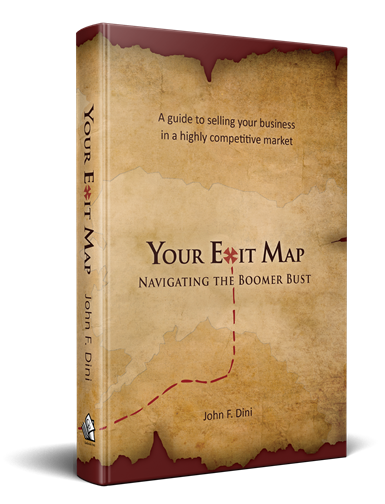
Last week we discussed the tsunami of Baby Boomer retirement, and how we will reach a peak of nearly 500 unsold businesses a day within the next 5 years. The statistics are immutable. The birthrates of the last century are fixed in stone. (If you haven’t read my e-book Beating the Boomer Bust you can get it for free here. Use the download code “Woodstock”.)

Once you understand the inevitability of competing to sell your business in a buyer’s market,  you have five choices.  The first  is to simply ignore it and hope for the best. For any owner who holds most of his or her net worth in the company, that’s not a great option.

The second is to watch, and wait for an opening. That requires following small business sales for favorable trends, and a flexible retirement plan that can take advantage of market conditions or an unexpected opportunity.

The third is planned liquidation. If you can achieve your financial goals by running the business a while longer, and you choose not to invest in building a company that runs without you, this is a viable strategy, albeit without the satisfaction of a large final payday.

The fourth is to build a business suitable for sale in a highly competitive environment. Such a company must have strong systems, dependable revenues, accomplished management (not including you), and profitability greater than most other companies a buyer might consider, whether those are in your industry or not.

handoffThe fifth strategy is to build your own internal exit plan, and execute it without many of the unknowns involved when taking your business to the market. It requires choosing an insider (family or employee) who understands the business, and is happy to have the opportunity to own it. Of course, that person should also have the ability to run it successfully, or at least the potential to learn those skills.

But wait. Didn’t I just write last week that selling the company to employees for a note was a terrible exit plan? I did, and it is. Selling the company to insiders doesn’t require that you bet your retirement on their continued success. With time and careful planning, it can be done in a way that minimizes or eliminates your risk.

First, any owner has to accept the fact that the company’s cash flow is the only means of payment for a purchase. Whether a buyer gives a note to you, borrows the price from a third-party lender, or invests cash with the expectation of a return on investment, the profits of the company are the source of repayment.

Selling to an insider is  a process where you take a note from the buyer before you leave, while you are still in control of the business. The buyer’s right to purchase is predicated on improving performance. You surrender some immediate income in return for incentive triggers that make your total sale price equal to or higher than what you would currently realize.

Once your internal buyer accumulates sufficient equity to qualify, he obtains a loan for the balance of your ownership. You receive 80% or more of your target price on the day you retire, and walk away with minimum ongoing liability. (I say 80% because most financial institutions like to see some incentive for the former owner to watch and advise for a few years. It can be up to 100%, depending on the lender and the company.)

With the right plan and the right people, the business transfers at a fair price with minimal cost and lower risk. The buyer(s) (whether one person or a management team) are incented to keep growing the business to qualify for ownership. While they are doing that, they are also assuming the management duties from you as a prerequisite for ownership.

Most important, you maintain control of the business until you are paid. For most owners, that is the most influential argument of all.

This is a column about the general issues of business ownership. I discuss exiting regularly because it is an important issue, but it isn’t the only aspect of ownership we discuss here. To receive my biweekly newsletter on exit strategies and issues, please subscribe here.

Picture Credit

Posted in Entrepreneurship, Exit Planning, Exit Strategies | Tagged , , , , , , , , , | Leave a comment

Leave a Reply

Your email address will not be published. Required fields are marked *

Ready…Set…Exit! Part I

For the last six years I’ve been writing and speaking around the country to business owners about the coming tsunami of retiring Baby Boomer business owners. My e-book “Beating the Boomer Bust” details the  statistics (For a free download, go here and enter the seminar attendee password “Woodstock”), but the numbers are inescapable.

According to www.bizbuysell.com the brokerage industry reports the sale of less than 8,000 small (under 500 employees) companies each year. There are between five million and six million such businesses in the USA that are owned by Boomers between 48 and 68 years old. That makes business owners about 7% of the Boomer generation (78,000,000).

By 2018, Boomers will be reaching their 65th birthday at a rate of 8,000 a day. That pencils out to over 550 business a day reaching  a logical point of sale. At current volumes, the brokerage industry can handle from January 1st almost through January 15th of every year. The other eleven and a half months you are on your own.

There are hurricanes, super storms, and perfect storms. The arrival on the ownership scene of GenX and the Millennials, who have less money and less enthusiasm for 60-hour work weeks, makes the wave of retiring owners a super storm. The need of big businesses to replace their retiring Boomers by offering higher salaries, better benefits and more flexibility make it into a perfect storm.

out the doorOf course, business brokers and the burgeoning industry of exit planning professionals (disclosure: I am certified in both) intend to cash in on the wave of sellers by vastly increasing their businesses. Even with a shortage of buyers, I’m sure they can double or triple their number of successful sales. Tripling would reduce the number of unsold businesses to only 485 per day. That’s 20 small companies with employees unsold hourly… 24/7/365. Do the math.

Of course, not all of the companies that change hands sell through business brokers. Some are passed on to families. Many are acquired privately, with accountants or attorneys facilitating the transactions. Others are sold to employees.

For small business owners, the third option, selling to employees, is too often the option of last resort. Owners ask their legal and financial advisors what to do. They prepare their company for sale (for a really solid new book on getting your company ready for a third-party sale check out The Exit Strategy Handbook by Jerry L. Mills). They list the business on the Internet or with a broker.

For any number of reasons, the business doesn’t sell. Perhaps they don’t have enough time because  the owner is burned out or ill. Their return on assets is too low, or their industry outlook is poor. The financial markets are tight, or there are just too many other businesses available for a limited number of buyers.

Finally, in desperation, they “sell” the business to employees for an installment note. In some ways these transactions often resemble the subprime mortgage market. The employees really aren’t qualified to grow the business. They need a job, and the terms can be stretched to any length to fit the cash flow available, so they are willing to sign whatever looks sustainable. If they don’t make the payments, the only recourse is for the owner to take back a company that he doesn’t want, and whose value has declined.

It’s a bad way to get rid of a company, but for many owners it is the only one they have left. It doesn’t have to be that way. We will talk about the alternatives next week.

Picture Credit


Posted in Entrepreneurship, Exit Planning, Exit Strategies, Management | Tagged , , , , , , | Leave a comment

Leave a Reply

Your email address will not be published. Required fields are marked *

Customer Service Starts with “Hello.”

When asked what differentiates their businesses from giant competitors, most owners will describe their relationship with customers.

“We give better service.” “Our employees know our customers by name.” “We treat people as individuals.”

What constitutes excellent service differs by industry and region. I’ve lived for long periods on the east coast, in Southern California, and now in Texas. Common retail courtesy is distinctly different depending on your location.

In New Jersey, I’m sure that retail cashiers are trained to greet customers and thank them for their business. After a few thousand rebuffs, however, many sink into robotic recital, expecting neither an answer nor a reaction.

In Los Angeles, most cashiers will greet you with a cheery hello and ask how you are today. When a customer replies, they often appear to be at a loss. Apparently they have been trained to act friendly, but it doesn’t occur to them that it could actually result in dialogue.

In Texas it took me some time to understand appropriate check-out behavior. The cashier would greet me and ask how I was. Then she would stop. I belatedly realized that she was waiting for a response, which is what polite folks do in Texas when asked a question.

As the Great Recession trimmed revenues, many small businesses reduced employee head count. In some companies, the “Director of First Impressions” position was eliminated, and the job of greeting and answering phones shifted to someone else. In others, the position remained, but was expanded to include more administrative responsibilities.

swamped-receptionist-In too many cases, greeting strangers has become a lower priority than other assigned duties. I deal with many businesses, and in more than a few I’m not acknowledged by the person at the front desk until she has completed some other task. When I call on the phone, it often goes like this:

“Good Morning, ABC and Associates.”

“Good Morning. This is John Dini from The Alternative Board. Is Bob Johnson available?”

“I’ll have to check. Who did you say was calling?”

“John Dini from The Alternative Board.”

“And what is this regarding?”

“Mr. Johnson asked me to call and  follow up on a meeting we had last week.”

“Okay… What did you say your name was?”

“John Dini.”

“And what was your company?”

“The Alternative Board.”

“What’s that?”

“It’s an organization of business owners in which Bob is considering membership. Is he available?”

“I don’t know. From where I sit I can only transfer you to his extension.”

I wish I could say this is an extreme example, but it’s more of a daily occurrence. Even when I am calling a long-time client, this conversation can happen if the usual receptionist is absent or on a break.

Customer service is easy when someone is already a customer. In retail, that is a pretty good assumption when they walk in the door. In other industries a stranger may or may not be a prospect, a vendor or a referral source. Can you really afford to make every new interaction a crapshoot?

Anyone who comes into contact with outsiders at all should be trained in how you expect your business to be presented. Until your entire organization understands that a commitment to excellent service starts with “hello”, you may be missing out on potential business.

Picture Credit

Posted in Management, Thoughts and Opinions, Uncategorized | Tagged , , , , , , | 1 Comment

One Response to Customer Service Starts with “Hello.”

  1. candi says:

    Great article and so true!

Leave a Reply

Your email address will not be published. Required fields are marked *

Size Means Nothing on the Web

A small manufacturer hires a local web development firm, and spends six months reworking his website. He agonizes over every word of the copy. He writes up product descriptions, detailing materials and tolerances. He adds page after page to the original project, as he develops line sheets, specs and usage instructions. He takes many of the product pictures himself. He fusses over the themes and colors. Many tasks that he performs in his business are delayed, because he is “working on the website.” Finally, he signs off on the whole thing and the site goes live.

The next day, a new European customer calls, asking for quotes on the largest single order he’s sold in five years. They began looking for a vendor that morning, and were impressed by the detailed, helpful information on his website.

A small distributor decided to invest in online cataloging for their customers. The software was expensive, and building the catalog with thousands of items took several years to complete. With no in-house IT staff, they were near surrender over the complexities several times, but they persevered. In the last two years, their business has grown by 50% as time sensitive (but not price sensitive) customers have “discovered” them as a local will-call source for items they were previously ordering…on the Internet.

Size means nothing on the web. Customers can only judge you by the professionalism and utility of your website. Many small business owners deliberately avoid investing in their websites. Their most frequent excuse is “Customers who buy on the ‘net are only looking for price.” That isn’t a new phenomenon. Businesses have been taking “How much do you get for…?” telephone calls for years. The Internet just allowed those people to price shop without long distance charges. (They were cheapskates to start with.)

price buyersShould you avoid the Internet because someone in East Oshgosh, whom you would have never heard from five years ago, now calls you before they don’t buy? That isn’t a lost sale, it’s a never was and never gonna be. To avoid the irritations of a few window shoppers, business owners decide to avoid all Internet shoppers.

About ten years ago Ford Motor Company surveyed customers in their showrooms. They asked how many people had used the Internet to make decisions regarding make, model, features and price before visiting a dealer. They were stunned when over 70% replied that they had. That was ten years ago.

In 1998 I asked my business owner clients if we could use email to send notices and reminders. Ninety-five percent said “no.” By 2002 we had only 3 clients who weren’t using email. By 2003 we had none. By 2005, over 90% of our clients said that they preferred email communication to other means of contact. Now we don’t even ask.

Fifteen years ago small businesses didn’t have websites. Ten years ago a website was to establish basic credibility. Today, regardless of your business, your website has to communicate who you are and what you do, along with your Unique Selling Proposition, product or service differentiation, service commitment, target customer, industry recognition and testimonials.

Would you prefer to miss the largest order in five years, or a 50% growth in business, just so you don’t have to deal with the price shopper in East Oshgosh?

Picture Credit

Posted in Marketing and Sales | Tagged , , , , , | 1 Comment

One Response to Size Means Nothing on the Web

  1. John Hyman says:

    Your post is spot on. As a marketing firm that also designs and builds websites we are amazed when we meet a prospect who doesn’t even have a website. It’s 2014. The right website and strategy can extend your marketing reach well beyond your geographic footprint, while leveling the playing field against competitors of all sizes.

Leave a Reply

Your email address will not be published. Required fields are marked *